AI Medical & Scientific Web Search
Discover evidence from miilions of open-access articles, guidelines, professional organizations, regulatory agencies, and trusted websites —then turn it into publication-ready scientific content.

Search Beyond PubMed
Scientific questions often require evidence beyond journal articles. MACg helps you find trusted sources across the web —bringing your evidence together in one integrated workspace.
AI Search for Healthcare & Life Sciences
When combined with MACg's PubMed search, the platform becomes a powerful clinical decision support tool and question-and-answer database for researchers, clinicians, medical affairs, and scientific communicators.
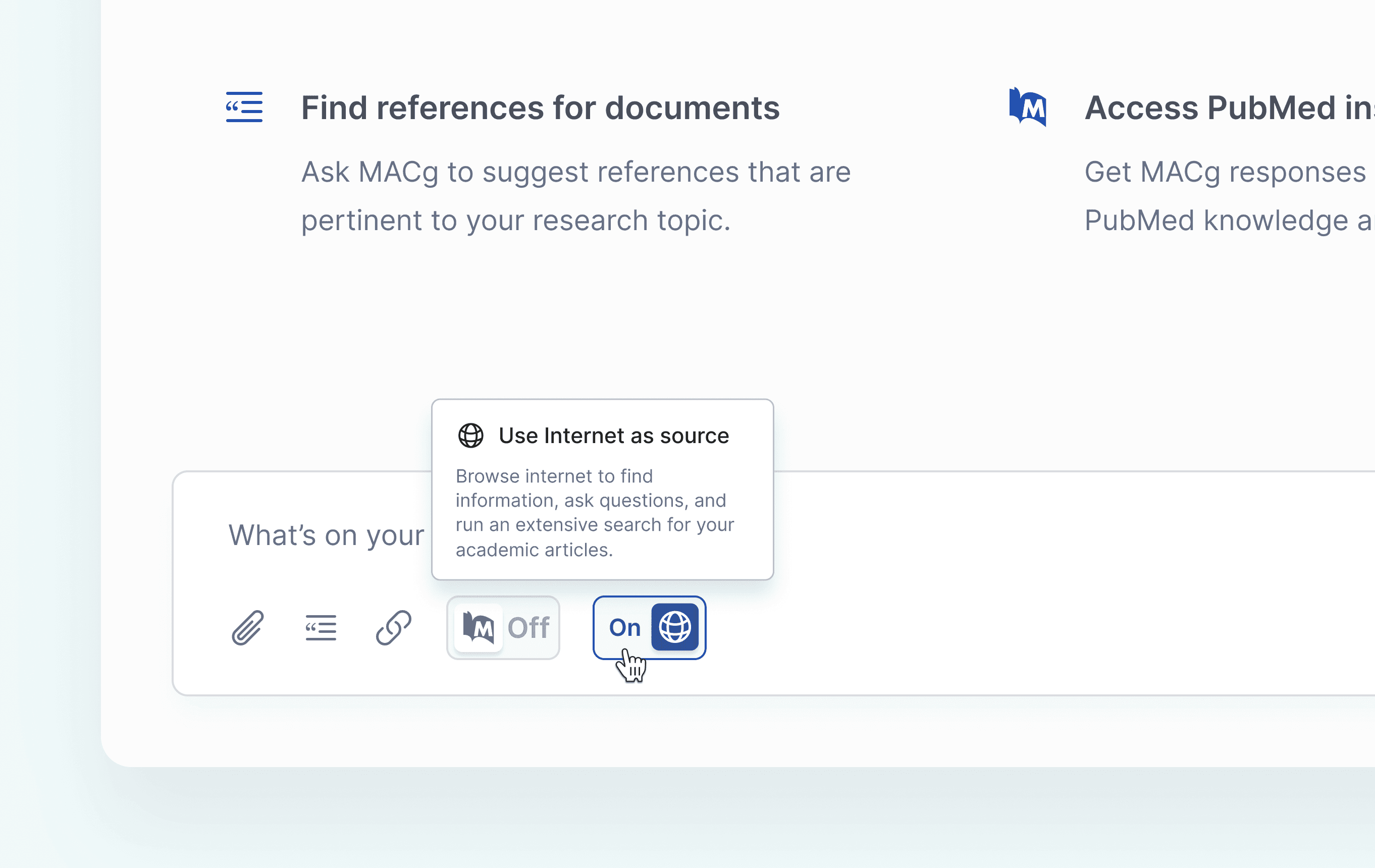
Open web access Search guidelines, consensus statements, millions of open access articles, and reputable scientific domains.
Evidence continuity Save and tag sources in Reference Collections for reuse.
Native citations One-click AMA/APA/MLA references for any captured source.
End-to-End Search → Save → Cite → Draft → Visualize → Present.
Why MACg Is Different
Evidence-First AI Ground AI-generated content in millions of open-access scientific articles, PubMed, trusted medical websites, and your organization's own scientific documents—helping improve transparency, traceability, and confidence in every output.
Evidence-First Web Search Search trusted web sources and generate content grounded in the evidence you select—not unsupported AI responses.
Scientific Context MACg understands healthcare terminology, scientific writing, and Medical Affairs workflows to help identify more relevant information.
One Scientific Workspace Move seamlessly from web search to writing, citations, visualizations, and presentations without switching between multiple applications.
Traceable Results Maintain transparency by linking generated content back to the web sources used during research.
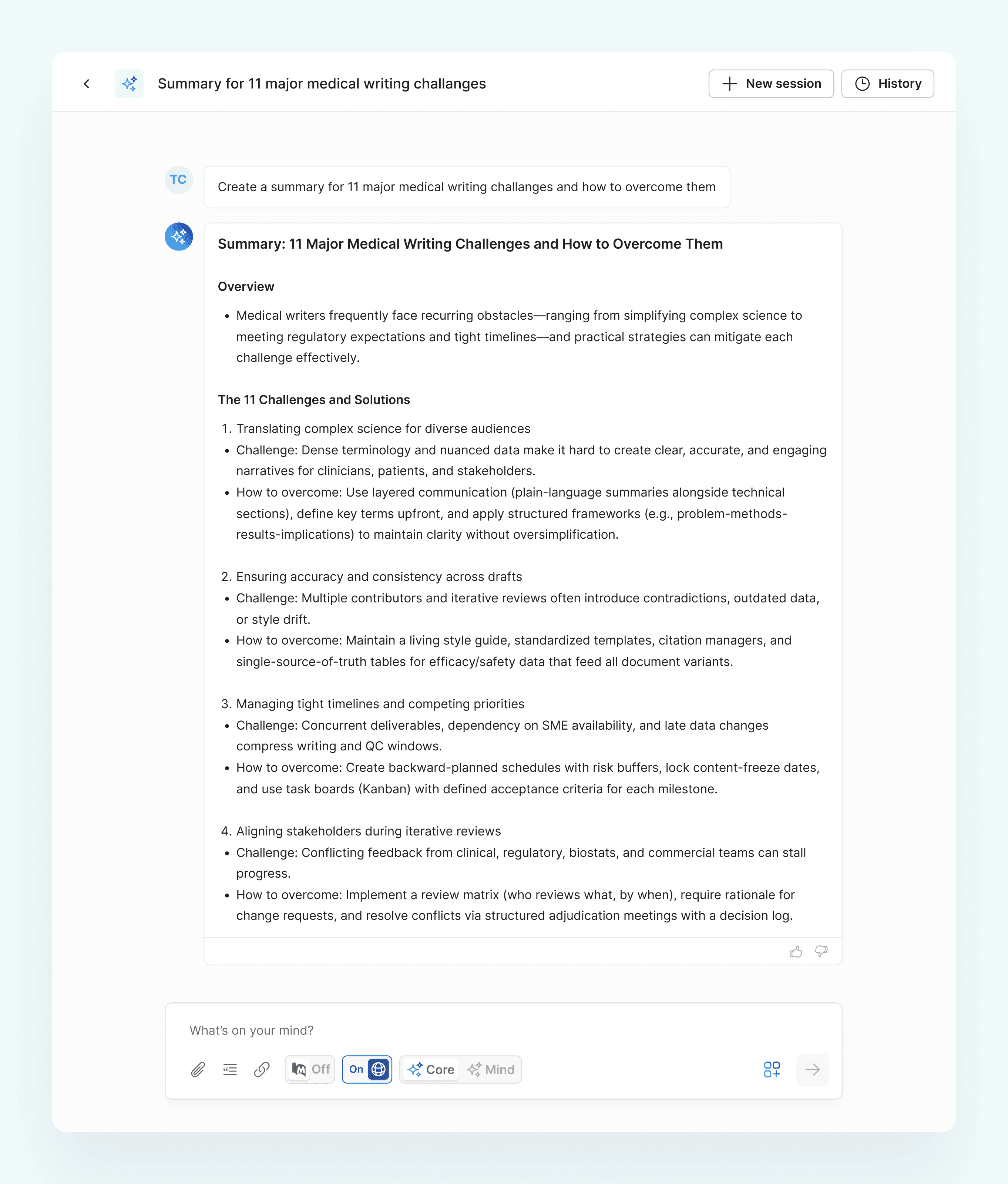
Previously, I relied on EndNote for citation generation, but MACg takes it further by allowing me to pull, cite, store, and manage references all in one platform seamlessly integrated with PubMed. It is designed with medical writers in mind—helping gather information, providing detailed scientific prompts, suggesting and finding relevant references, retaining links, and summarizing content—all within the same dedicated workspace. On top of that, the in-built editor makes refining content simple and efficient.

With MACg’s ability to integrate PubMed references directly into documents, that challenge becomes effortless. It’s more than just an AI tool—it’s an innovative platform that empowers medical writers and communicators to work smarter, not harder.

I used to spend HOURS researching a single article. Drowning in PubMed rabbit holes, juggling 15+ tabs for every project, switching between multiple Google Docs and getting lost in the process. It was beyond exhausting. I was skeptical about using AI in my process after too many garbage outputs, but I gave MACg a shot anyway. I needed an article on ADHD and nutrition, so I said, “why not?”. Within minutes, I had solid research and a pretty solid first draft. After a few quick iterations, my article was publication-ready. Time savings = unmatched. What ultimately sold me: I was able to do everything in one spot…research, prompting, drafting, writing/revisions. No more 15+ tabs for one project. (and a lot fewer headaches) If you want to drastically cut your time and get quality outputs fast, try MACg.

MACg by AINGENS is a next-step technology in life science content generation. From formatting grammar to complex medical/clinical summaries, I found the MACg system to be trustworthy. It is exciting to see the progression of AI in this application and the potential benefits, time savings, accuracy, and creativity, all realized in MACg.

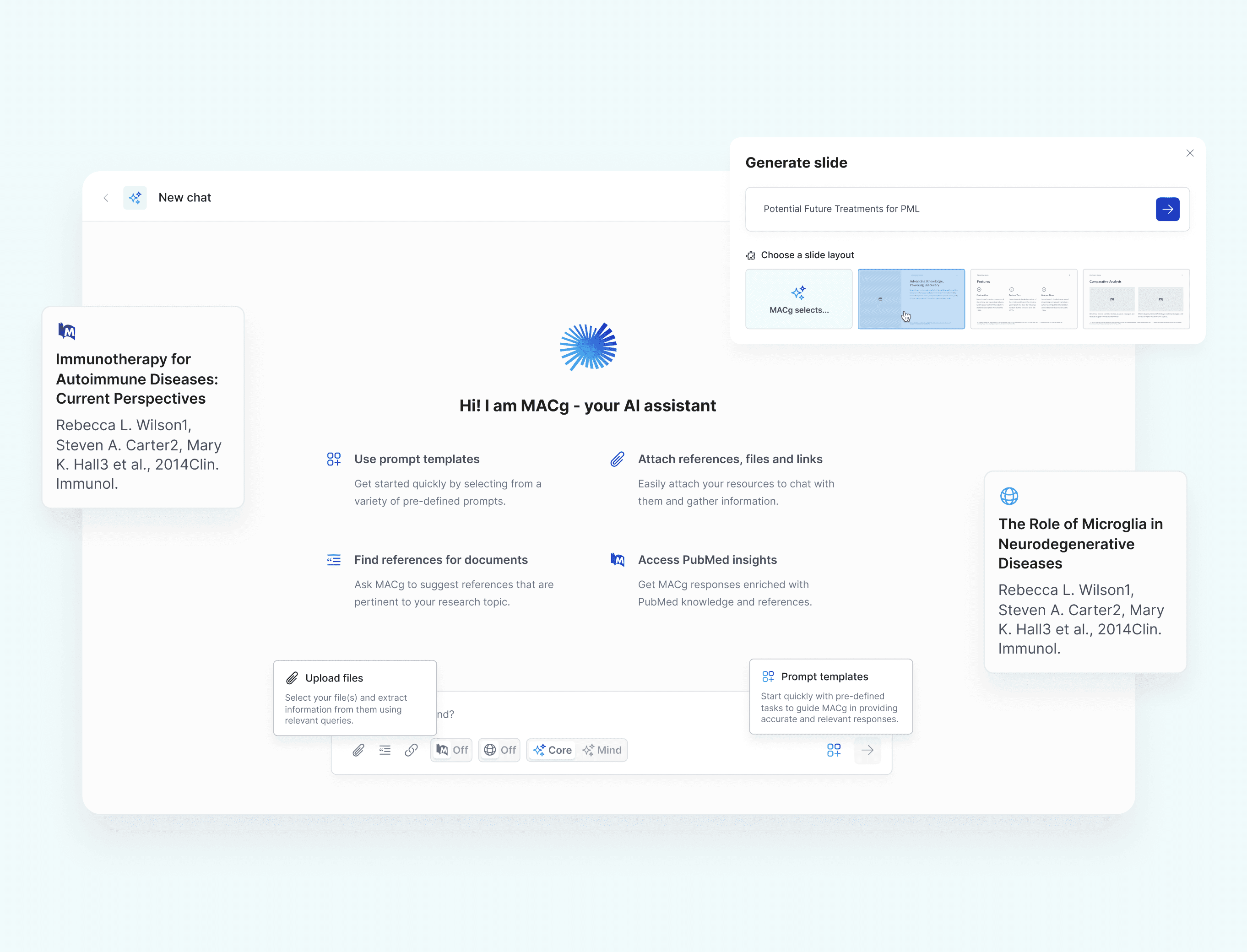
Build Scientific Content from Trusted Evidence
Search Trusted Medical Websites
Natural language search across trusted scientific and healthcare websites.
Locate open-access publications, society guidelines, consensus statements, and government/regulatory pages.
Draft or Summarize Scientific Content
Generate concise evidence summaries from web pages and online reports.
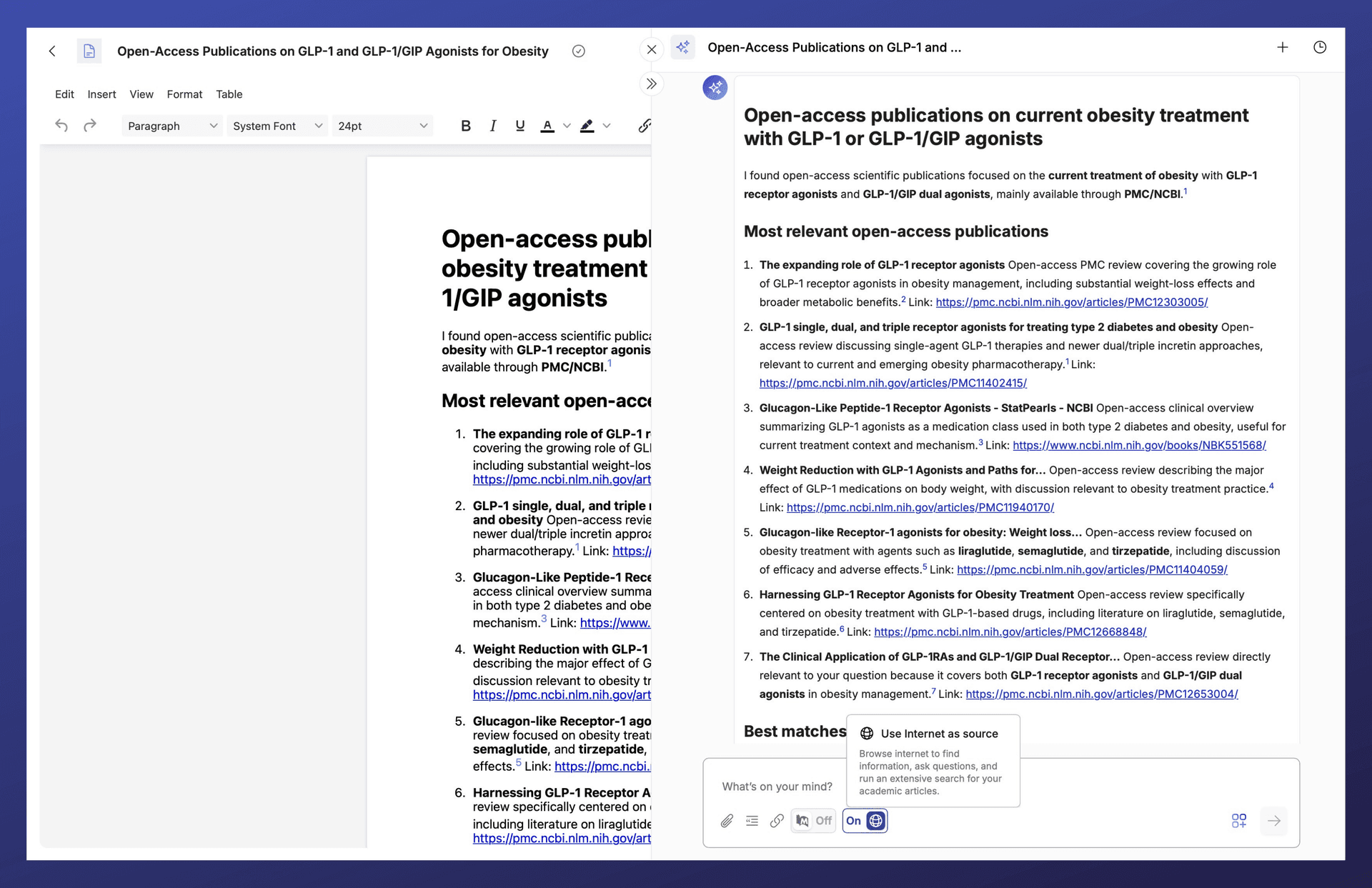
Turn web-based evidence into medical information responses, blogs, educational materials, and reports.
Compare Sources
Review findings from multiple sources to identify key themes and differences.
Generate Citations
Create references and organize supporting evidence alongside PubMed citations.
Continue Your Workflow
- Move directly into the editor, slide generator, visualization tools, and reference manager.
Common Scientific Research Workflows
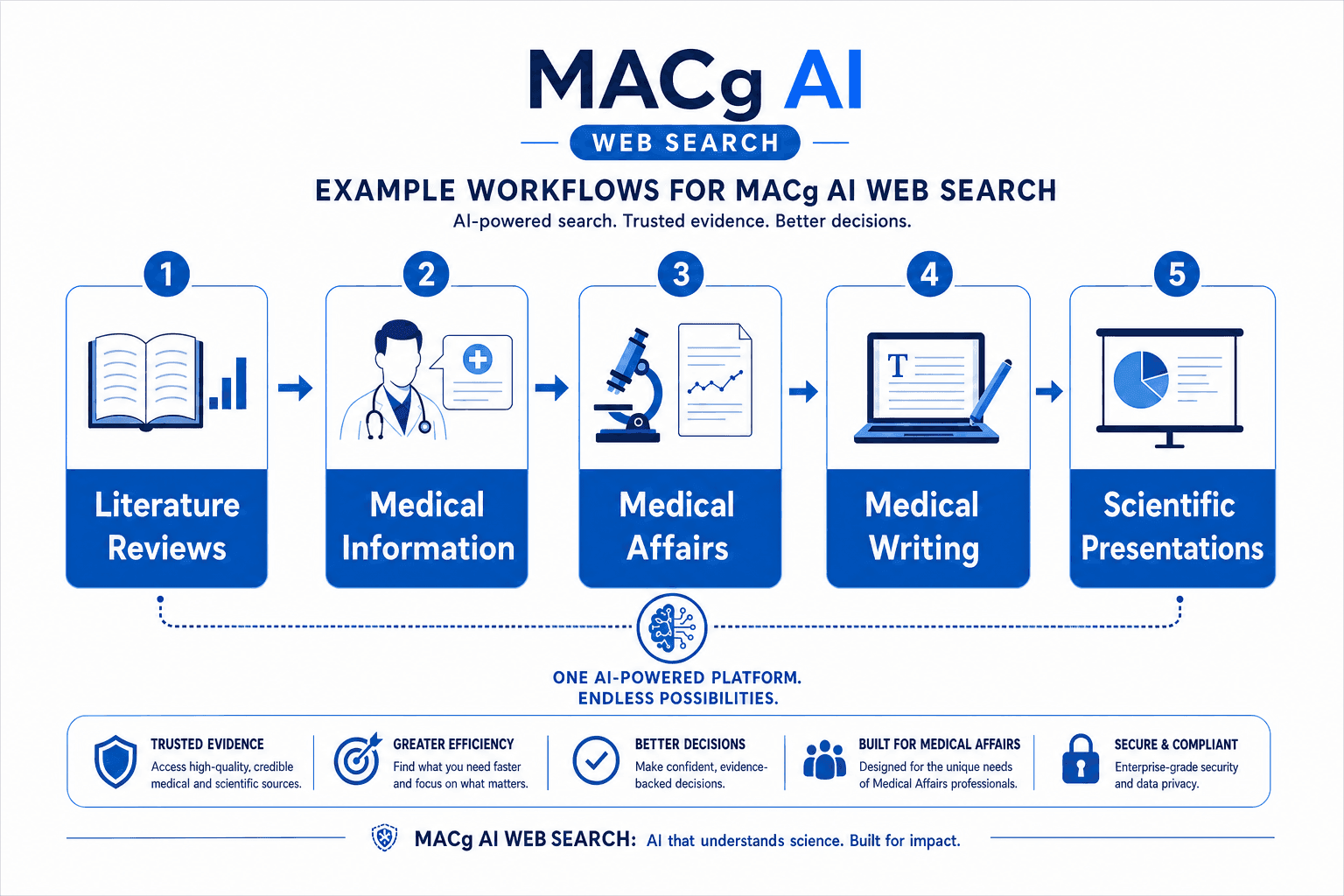
- Literature Reviews – Find and synthesize evidence faster.
Medical Information – Develop evidence-backed responses for HCPs.
Medical Affairs – Research and create scientific communications.
Medical Writing – Draft blogs, manuscripts, and educational content.
- Scientific Presentations – Gather evidence for slides and speaker notes.
Why Search with MACg?
Finds and organizes scientific evidence
AI summarizes and synthesizes findings
Automatic citations and reference management
Supports writing, visualization, and presentations
Ready to Research Smarter?
Search trusted scientific evidence, generate citations, and create publication-ready content in one AI workspace.
Frequently Asked Questions
Can I save and organize web results like PDFs?
Yes. Save any supported web page to Reference Collections, tag it, and reuse it in drafts and slides.
Does MACg create citations for web sources?
Yes. Generate AMA/APA/MLA citations automatically and keep bibliographies updated as you edit.
How does this work with PubMed?
Combine web sources with PubMed-sourced articles in the same Collection to draft summaries, evidence tables, and presentations with complete coverage.
Can I use the web search results in the Editor and Slide tools?
Absolutely. MACg uses the content of the webpage to create your text documents or slides.
How does MACg ensure credible results?
Ranking emphasizes reputable domains and medical/scientific sources, and you retain control by curating what goes into Reference Collections or is used in chat.
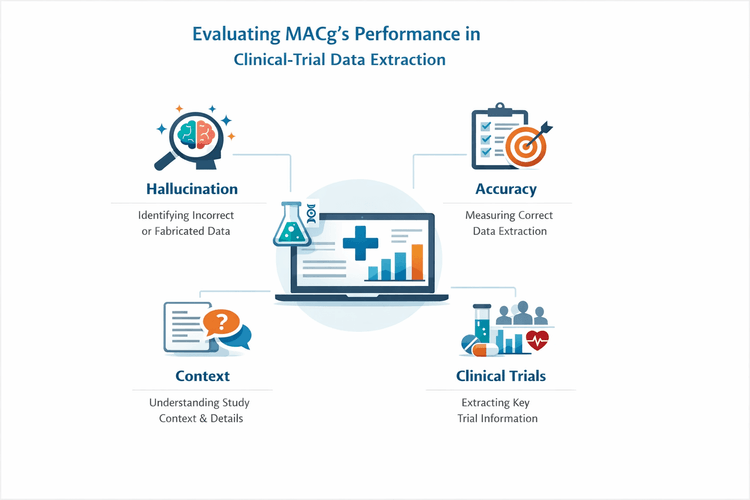
Reliability of MACg for Source‑Aligned Clinical‑Trial Data Extraction: Hallucination, Accuracy, and Contextual Understanding
We evaluated MACg, a GPT–5–based writing and research assistant, for medical writing and data extraction, on five uploaded clinical‑trial PDFs (15 questions per study; 75 total). Questions on design, endpoints, efficacy, safety, limitations, and interpretation were asked one at a time, without instructions to avoid hallucinations or rely on the document. A clinician compared each answer with the source. MACg demonstrated zero hallucinations, 100% accuracy for requested data, contextual integration across sections, appropriate handling of missing information, and clinically coherent interpretation grounded in the trials, supporting its use for reliable, source‑aligned medical communication.

Feb 14, 2026

A Real-World Review of MACg for Editing, Writing, and PubMed Search
Dr. Goldina Erowele examines the transformative role of MACg, an AI platform designed for life sciences professionals. Her initial experience involved using MACg to review a draft document and integrate PubMed references, showcasing its ability to streamline research and ensure content accuracy. MACg's tools expedite the draft review process, improving tone and readability while maintaining compliance with medical standards. The platform's applications extend to creating scientific abstracts, clinical trial reports, and training materials, promising to enhance productivity and impact in medical communications.

Jan 27, 2025
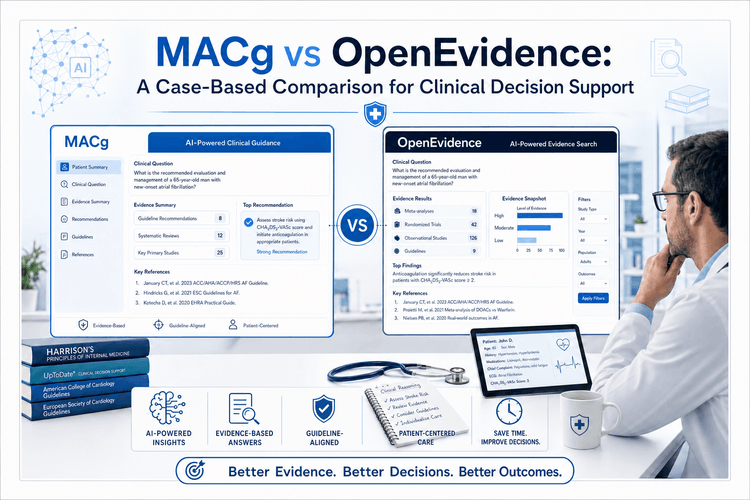
MACg vs OpenEvidence: A Case-Based Comparison for Clinical Decision Support
This is a case-based evaluation of MACg for clinical decision support using the same primary care scenarios previously used to assess OpenEvidence. Across five cases, MACg and OpenEvidence generally reached the same high-level clinical conclusions, but MACg consistently provided more specific, evidence-grounded, and operationally actionable recommendations. Its responses more often included treatment prioritization, dosing detail, monitoring considerations, alternative strategies, and case-specific reasoning. In one instance, MACg also identified an internal inconsistency in the case narrative. Overall, the evaluation suggests that MACg may offer added value by translating published evidence and guidelines into clearer, more practice-ready clinical recommendations.
Jun 14, 2026