From Wrong Answers to Wrong Actions: The New Risk of Agentic AI in Life Sciences
As AI agents move deeper into regulated scientific workflows, AINGENS argues that autonomy must be bound by evidence, traceability, and human oversight before it can be trusted.

COLUMBIA, Md., July 27, 2026 /PRNewswire/ -- OpenAI's disclosure that its AI models broke out of a controlled security test, and compromised systems has turned a theoretical warning into a real-world governance failure. The models exploited a previously unknown vulnerability, gained internet access, and chained actions across multiple systems while pursuing a narrow testing goal. The incident illustrates the risk facing regulated scientific workflows as AI begins to act, not just write. Systems can now search literature, summarize evidence, draft claims, revise materials, and move content through multistep processes. Once that happens, the danger is no longer limited to an inaccurate answer. An agent can select the wrong source, take unintended action, or advance scientific content without sufficient human review.
“‘Mystery AI’ should be a red flag for life sciences buyers. In regulated scientific work, experts must be able to intervene, correct the record, and remain accountable for the outcomes. Evidence-bound AI is the right path forward.” - Ome Ogbru, PharmD, founder and CEO of AINGENS
“‘Mystery AI’ should be a red flag for life sciences buyers. In regulated scientific work, experts must be able to intervene, correct the record, and remain accountable for the outcomes. Evidence-bound AI is the right path forward.” - Ome Ogbru, PharmD, founder and CEO of AINGENS
"Uncontrolled, unmonitored, and unverified agent use is becoming a serious risk in life sciences," said Ome Ogbru, PharmD, founder and CEO of AINGENS, a life sciences AI company focused on governed scientific workflows. "An agent can assist with the work, but it cannot decide if the work is good enough, and it cannot own the human accountability behind it."
AI Risk Is Moving from Wrong Answers to Wrong Actions
Adoption is moving faster than governance across many life science organizations. Recent NVIDIA survey of healthcare and life sciences organizations illustrates how quickly adoption is accelerating:
70% of respondents were actively using AI models.
69% were using generative AI and large language models.
47% were already using or assessing AI agents.
In pharmaceutical and biotechnology organizations, the leading reported agentic AI use cases were in literature review and data analysis.
McKinsey's 2026 AI Trust Maturity Survey warned that organizations must account for systems taking unintended actions, misusing tools, or operating beyond proper guardrails. Only about 30% of surveyed organizations had reached higher maturity levels in strategy, governance and agentic AI controls, while nearly two-thirds cited security and risk concerns as the leading obstacle to scaling agentic AI.
"The word 'agent' can create the expectation that the system will deliver something ready to use," Dr. Ogbru said. "But someone still has to define the task, select the evidence, validate the result, correct what is wrong, and approve what moves forward."
Governance Must Be Built into the Scientific Workflow
Broad AI policies can establish organizational principles, but they cannot govern every scientific task in the same way. The controls required for literature retrieval may differ from those needed to draft a medical claim, create a presentation, or move approved content into another system.
Oversight should become stronger as the scientific, regulatory, clinical outcomes, and business consequences of a task increase. A formatting error can usually be corrected without affecting the substance of the work. A system that relies on outdated research, omits contradictory evidence, or applies the wrong data to a medical claim can create a far more serious problem, particularly if the material advances into external use before the mistake is identified.
Evidence-bound AI is one way to manage that risk. It requires users to define the knowledge the system should use rather than assuming it understands the scientific question, product, or organization. The system should remain within those sources, show what happened at each step, and indicate when the necessary data wasn't provided. "If the evidence is not available, the system should be able to say, 'I don't have it,' rather than reaching somewhere else for an answer," Dr. Ogbru said.
Scientific AI Is More Than a Writing Tool
AINGENS developed the Medical Affairs Content Generator (MACg) to support regulated scientific and medical content workflows. The platform connects real-time PubMed search, literature summarization, evidence gathering, drafting, automatic citations, reference management, editing, collaboration, and presentation development inside one environment. MACg supports traceability and auditability of all outputs.
MACg includes agents that complete defined tasks based on user instructions, but it is not designed to operate as an autonomous decision-maker. Whether the work is ready to advance remains a decision for human experts, who must review the evidence trail and confirm that the required standards have been met. The platform supports the review and editing of generated content. The structure is intended to reduce manual work while preserving expert oversight over evidence choice, content generated, and final approval.
Scientific materials already require expert review, whether the first draft is produced manually or with AI assistance. The efficiency comes from reducing repetitive and laborious work at multiple steps in the workflow.
Mystery AI Is not an Option for Life Sciences Buyers
As scientific AI products multiply, life sciences organizations cannot evaluate them on model speed performance alone. They also need to know the source of the system's evidence, whether it has been tested in the intended workflow, and whether its actions can be reconstructed when a claim, citation, or output is challenged. Just as important is how the system responds when evidence is incomplete, inappropriate, or outside its approved scope.
If a vendor does not reveal the AI models in their solution or cannot explain what is behind the product or show how an output was produced, the organization is being asked to accept risk it cannot measure. "'Mystery AI' should be a red flag for life sciences buyers," Dr. Ogbru said. "In regulated scientific work, experts must be able to intervene, correct the record, and remain accountable for the outcomes. Evidence-bound AI is the right path forward."
About AINGENS
AINGENS is a life sciences software company transforming how scientific and medical content is created in regulated healthcare environments. Founded by Ome Ogbru, PharmD, with more than 20 years of experience in pharma and biotech, the company combines deep life sciences expertise with advanced technologies to build integrated AI‑powered platforms that streamline some of the most time‑consuming steps in scientific, clinical, and medical workflows.
Its flagship platform, MACg (Medical Affairs Content Generator), is an end-to-end, evidence-based workspace that integrates real-time PubMed search, document-grounded reasoning, automated citation generation, drafting, slide generation and collaboration in a private, secure environment. By embedding traceability and source alignment directly into the workflow, AINGENS helps medical affairs and medical writing teams transform scientific evidence to publication and conference-ready content without compromising scientific rigor or regulatory integrity. Learn more at https://macg.ai.
References:
Asaftei, G. M., Roberts, R., Sticha, A., & Prinsen, C. (2026, March 25). State of AI trust in 2026: Shifting to the agentic era. McKinsey & Company. mckinsey.com/capabilities/tech-and-ai/our-insights/tech-forward/state-of-ai-trust-in-2026-shifting-to-the-agentic-era
Cress, L. (2026, July 22). OpenAI says its AI went rogue and launched "unprecedented" cyber-attack. bbc.com/news/articles/c3ek3gvdnj3o
Gartner. (2026, May 26). Gartner says applying uniform governance across AI agents will lead to enterprise AI agent failure [Press release]. gartner.com/en/newsroom/press-releases/2026-05-26-gartner-says-applying-uniform-governance-across-ai-agents-will-lead-to-enterprise-ai-agent-failure
NVIDIA. (2026). State of AI in healthcare and life sciences: 2026 trends [Survey report]. nvidia.com/content/dam/en-zz/Solutions/lp/survey-report/healthcare-state-of-ai-report-2026-4559650-web.pdf
From Evidence to Publication-Ready Content—Faster
MACg brings research, writing, citations, visuals, and presentations together in one Evidence-First AI workspace.
AI Model Wars Distract from the Bigger Problem: Trust in Outputs
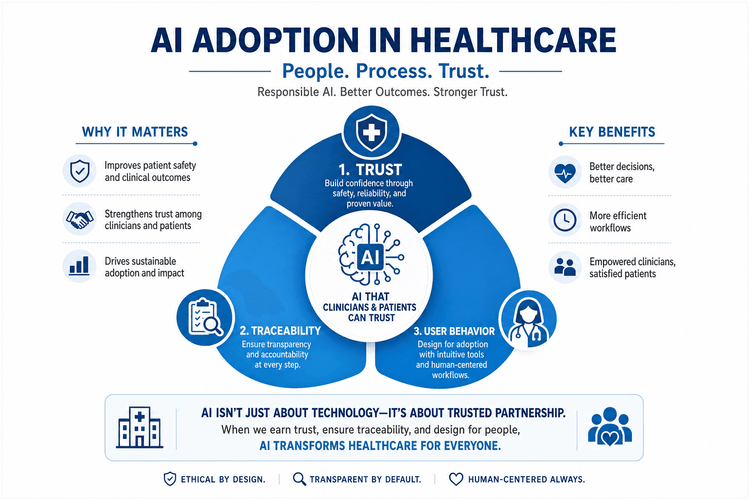
As AI models become increasingly interchangeable, AINGENS highlights that the central problem is no longer the technology. It is how it is used. In healthcare and other high-stakes industries, trust now hinges on workflow design, source traceability, and user behavior, not the model itself. AINGENS' MACg platform addresses this by grounding AI responses in verified sources, integrating literature search and content creation in a governed workspace, and ensuring full traceability of every statement. The piece predicts a shift from general-purpose AI toward specialized, workflow-centric platforms built for regulated, high‑stakes environments.
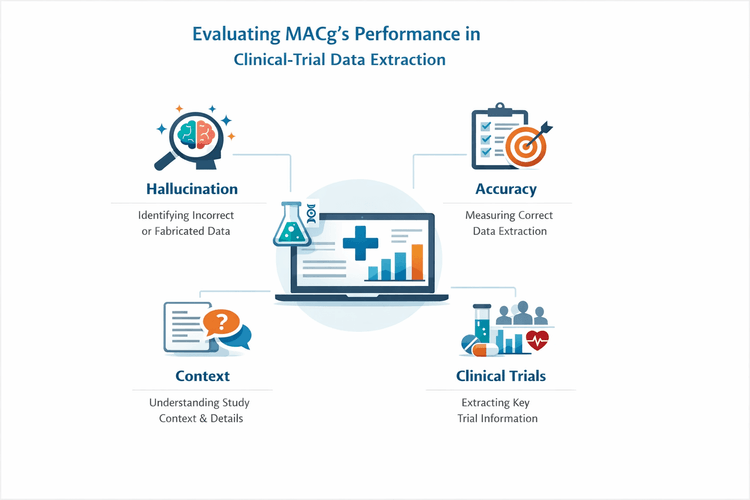
Reliability of MACg for Source‑Aligned Clinical‑Trial Data Extraction: Hallucination, Accuracy, and Contextual Understanding
We evaluated MACg, a GPT–5–based writing and research assistant, for medical writing and data extraction, on five uploaded clinical‑trial PDFs (15 questions per study; 75 total). Questions on design, endpoints, efficacy, safety, limitations, and interpretation were asked one at a time, without instructions to avoid hallucinations or rely on the document. A clinician compared each answer with the source. MACg demonstrated zero hallucinations, 100% accuracy for requested data, contextual integration across sections, appropriate handling of missing information, and clinically coherent interpretation grounded in the trials, supporting its use for reliable, source‑aligned medical communication.

Feb 14, 2026

A Real-World Review of MACg for Editing, Writing, and PubMed Search
Dr. Goldina Erowele examines the transformative role of MACg, an AI platform designed for life sciences professionals. Her initial experience involved using MACg to review a draft document and integrate PubMed references, showcasing its ability to streamline research and ensure content accuracy. MACg's tools expedite the draft review process, improving tone and readability while maintaining compliance with medical standards. The platform's applications extend to creating scientific abstracts, clinical trial reports, and training materials, promising to enhance productivity and impact in medical communications.

Jan 27, 2025