Resources & News
Articles
Blog categories
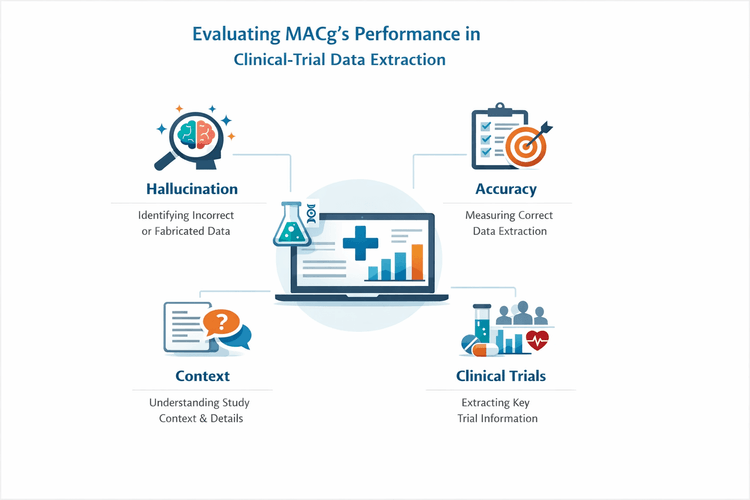
Reliability of MACg for Source‑Aligned Clinical‑Trial Data Extraction: Hallucination, Accuracy, and Contextual Understanding
We evaluated MACg, a GPT–5–based writing and research assistant, for medical writing and data extraction, on five uploaded clinical‑trial PDFs (15 questions per study; 75 total). Questions on design, endpoints, efficacy, safety, limitations, and interpretation were asked one at a time, without instructions to avoid hallucinations or rely on the document. A clinician compared each answer with the source. MACg demonstrated zero hallucinations, 100% accuracy for requested data, contextual integration across sections, appropriate handling of missing information, and clinically coherent interpretation grounded in the trials, supporting its use for reliable, source‑aligned medical communication.

Feb 14, 2026
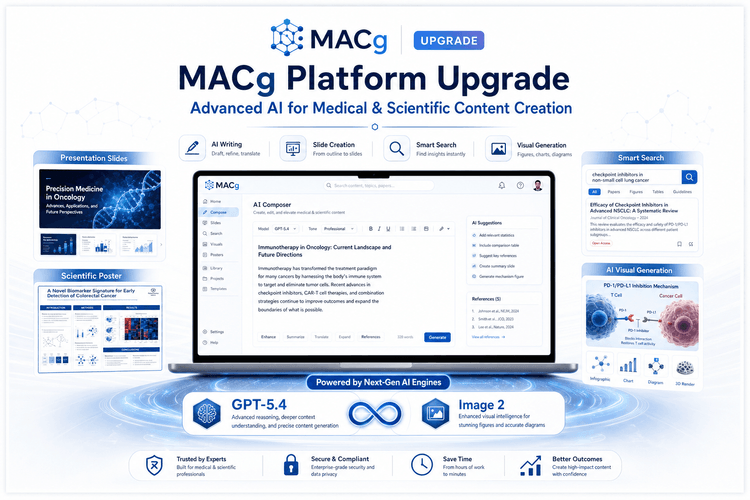
MACg Platform Update: GPT-5.4 and Image 2 Across Writing, Slides, and Visual Creation
This update reflects a major step forward in how MACg supports scientific and medical content creation. With GPT-5.4 now powering the platform, users benefit from stronger writing, better reasoning, improved responsiveness, and more consistent outputs across AskMACg, slide generation, and search. At the same time, the integration of Image 2 into both AskMACg and slide creation significantly expands MACg's visual capabilities, enabling users to generate higher-quality infographic visuals, presentation graphics, congress-ready posters, and other professional assets directly within the platform. The redesigned Slide Agent builds on these model upgrades with improved orchestration, greater contextual awareness, and more accurate slide generation. Together, these enhancements make MACg a more unified and capable environment for searching, writing, visualizing, and presenting complex scientific information. For users, this means a faster path from idea to polished deliverable, with stronger support for both narrative content and visual communication.
Jun 5, 2026

9 EASY TIPS FOR CREATING EFFECTIVE PRESENTATIONS - AINGENS
Imagine sitting through a research presentation that felt like an endless stream of slides with too much text. Sounds boring, right? No matter how comprehensive and innovative your research is, your message will be missed if your presentation isn’t interesting and well-organized. This post shares nine simple yet powerful tips for creating effective presentations. These tips will help you convey your research findings effectively, maintain audience interest, and leave a lasting impression.

Apr 21, 2025

8 TOP AI RESEARCH PAPER SUMMARIZERS in 2025 - AINGENS
Don’t even get me started on the technical jargon, the endless citations, and the effort it takes to piece everything together into something meaningful. If only there were a way to cut through all that complexity and get straight to the important stuff without losing the essence of the research. Good news! That’s where AI research paper summarizers come in. These tools are made to quickly scan, evaluate, and highlight the most crucial information from scholarly papers.
Apr 14, 2025
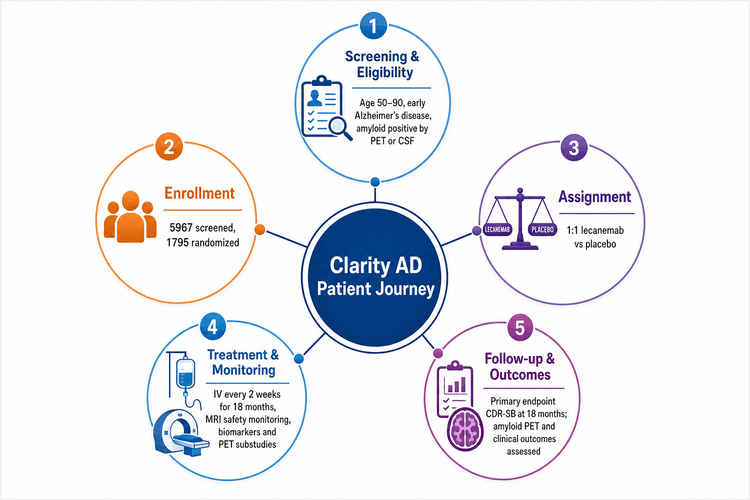
How to Create and Use Prompt Templates to Create PowerPoint Style Medical or Scientific AI Slides and Graphics
This article explains how prompt templates can help create clearer, more polished medical and scientific AI slide graphics. Instead of relying on vague requests, templates provide a reusable structure that makes AI-generated visuals feel more like professional PowerPoint slides and less like generic artwork. The article outlines the key parts of an effective template, including the topic, slide type, visual style, color palette, and layout instructions. It also shows how different formats, such as study design, patient journey, and key takeaways slides, can be matched to different communication goals. Readers will learn why strong prompts should be specific about layout, minimal in text, and designed with presentation use in mind. The included prompt examples are intended as practical starting points that can be customized for different studies, disease areas, products, or scientific messages. Overall, the article offers a simple framework for building more consistent, slide-ready visuals for medical and scientific presentations.

Jul 9, 2026

9 BEST AI TOOLS FOR RESEARCH PAPER WRITING - AINGENS
AI tools for research paper writing can make the entire process easier and more efficient. No, they won’t write your paper for you, but they eliminate the grunt work—helping you find relevant sources, structure your paper, refine your writing, and easily manage citations.
Apr 14, 2025
100 AI Slide Presentation Prompts for Busy Medical and Scientific Professionals
This article provides 100 ready‑to‑use AI prompts to help medical and scientific professionals create high‑quality slide presentations with MACg. The prompts are organized into practical categories, including clinical education, drug and mechanism‑of‑action decks, PubMed‑driven evidence reviews, specialty teaching, medical affairs and HEOR, training and curriculum, data‑visualization, and conference or grant presentations. Each prompt uses clear “Instruction:” wording and customizable placeholders (e.g., [condition], [audience], [timeframe]) so users can quickly adapt them to their specific topic and setting. By removing blank‑slide paralysis, the collection speeds up evidence‑based slide creation while supporting consistent, structured, and compliant communication.
Feb 4, 2026
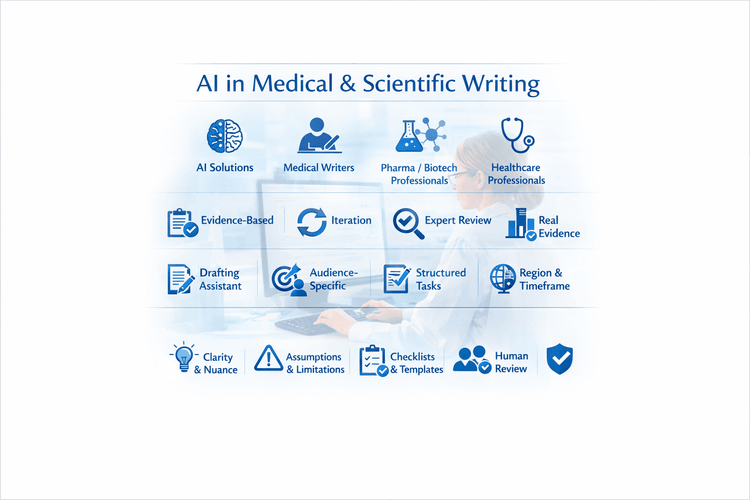
10 Tips For Using MACg and Other AI Solutions For Medical and Scientific Writing
This article shares 10 practical tips for medical writers, pharma/biotech professionals, HCPs, and researchers on how to use MACg and other AI solutions effectively and responsibly. It emphasizes that MACg's AI agent training knowledge is not a citable evidence base and must be anchored in real, verifiable sources such as publications, CSRs, labels, guidelines, and internal documents. Readers are encouraged to treat all AI outputs as Version 0.1, iterating with expert review rather than accepting the first draft. The article frames MACg as a drafting and thinking assistant, not an autonomous author, and stresses the importance of clear prompts about audience, purpose, region, timeframe, and scope. It recommends breaking complex projects into smaller tasks, using MACg to improve structure and clarity, and explicitly asking for limitations and caveats. Finally, it advocates creating institutional checklists and making expert human review and sign‑off mandatory for any impactful content.
Mar 1, 2026

A SIMPLE GUIDE ON HOW TO SUMMARIZE A RESEARCH ARTICLE [2025]
Have you ever struggled to learn how to summarize a research article? You’re not alone. Research papers are packed with technical jargon and endless data, making it a real struggle to extract the key points without getting lost in the details. However, with the right approach, you can break down even the most complex papers into clear, digestible summaries without spending hours staring at your screen.
Apr 21, 2025
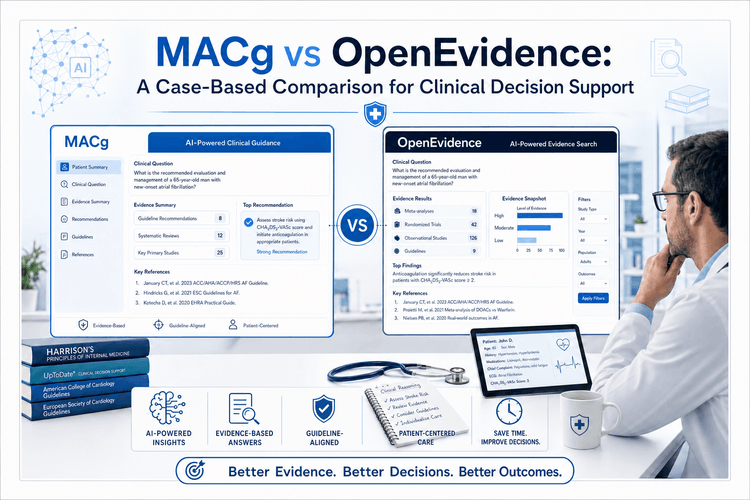
MACg vs OpenEvidence: A Case-Based Comparison for Clinical Decision Support
This is a case-based evaluation of MACg for clinical decision support using the same primary care scenarios previously used to assess OpenEvidence. Across five cases, MACg and OpenEvidence generally reached the same high-level clinical conclusions, but MACg consistently provided more specific, evidence-grounded, and operationally actionable recommendations. Its responses more often included treatment prioritization, dosing detail, monitoring considerations, alternative strategies, and case-specific reasoning. In one instance, MACg also identified an internal inconsistency in the case narrative. Overall, the evaluation suggests that MACg may offer added value by translating published evidence and guidelines into clearer, more practice-ready clinical recommendations.
Jun 14, 2026
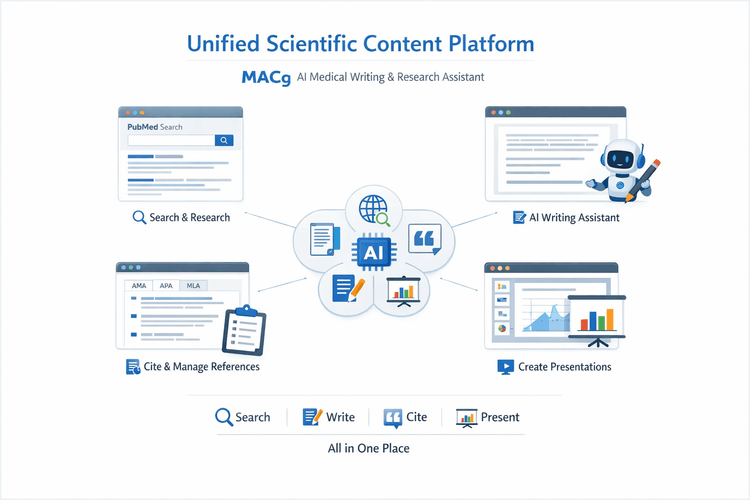
MACg Tutorials, Prompt Templates, and Tips
We have compiled helpfull resources and tips for getting the most out of MACg. Select the asset that meets your immediate needs. review general tips for using AI platforms effectively. Use the prompt templates to quickly craft your own effective prompts for creating many types of content. Pay special attention to article upload limit tips and breaking up large documents and slides into sections. Remember that the first draft is not the final output. You have to work with MACg to refine the output based on your directions. Using these resources and following best practices will help you get the most out of your MACg subscription.
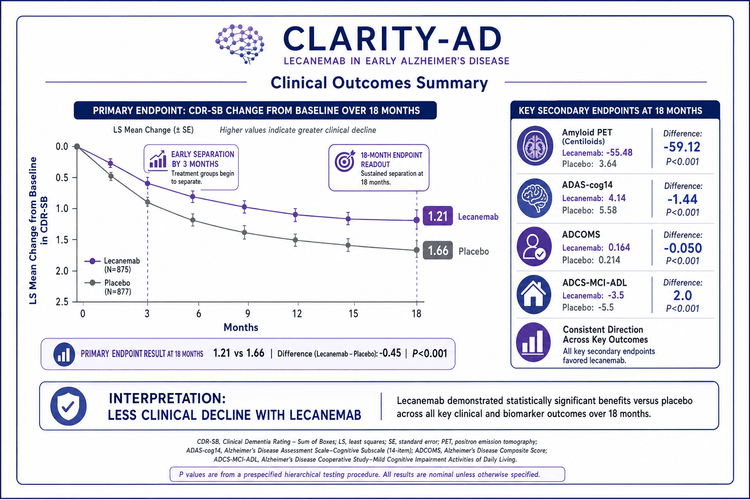
25 Medical and Scientific Slide AI Prompt Templates for Creating PowerPoint-Style Slides
These 25 medical and scientific AI slide prompts provide practical starting points for creating professional, PowerPoint-style visuals for scientific and healthcare presentations using AI slide platforms like MACg. They cover a range of common slide needs, including study design, patient journey, mechanism of action, efficacy, safety, timelines, biomarkers, and executive-summary takeaways. Each prompt is structured to help users generate graphics that are clean, readable, and visually consistent, with guidance on layout, style, color palette, and text density. These templates can be used as written or adapted to specific studies, disease areas, products, or communication goals, making it easier to build polished, slide-ready medical presentations with less time spent drafting prompts.
Jul 13, 2026

How To Use Generative AI In Life Sciences While Avoiding Data Security Risks
Artificial intelligence-powered platforms are the ultimate writing assistants, improving efficiency and increasing productivity in the life sciences industry. However, concerns about data security are limiting the deployment of AI at many institutions. Here are some tips for using AI in life sciences for content generation while avoiding security risks.
Nov 10, 2024

MACg: The AI-Powered Assistant Transforming How Life Sciences Professionals Search PubMed's 30 Million Articles
Navigating PubMed's vast database challenges life sciences professionals, often leading to overlooked insights. MACg, a specialized AI tool, transforms research by understanding scientific content, streamlining literature reviews, and enhancing content creation. It significantly reduces research time, enabling informed decisions and accelerating scientific discovery across various sectors.

Dec 10, 2024

How AI Will Transform Life Sciences Work and Careers
Artificial intelligence (AI) is more than a technological trend; it's a transformative force reshaping the life sciences. From drug discovery to laboratory practice and regulatory submissions, AI's integration offers unprecedented opportunities for biotechnology, pharmaceuticals, and healthcare professionals. Understanding how AI influences work and careers in this field is essential for staying relevant and excelling in an evolving industry.
Jan 2, 2025

Start creating & editing
content in minutes with
AINGENS’ MACg.
Discover all the amazing things you'll create with AI.