PubMed Literature Search
The MACg PubMed feature is designed to be specific to the user's search instructions and reduces the need to sift through 100s of search results. It combines proven biomedical literature search techniques with advanced AI agents to support search retrieval, summarizing, writing, and data visualization. The PubMed Search feature turns MACg into a powerful question-and-answer database and a clinical support tool.

How to Search PubMed and Review Literature
Overview
MACg is especially useful when you want faster, cleaner, and more structured PubMed searching without writing every query manually. It uses natural language search and is very precise to your request.
It is a powerful question-and-answer database for many use cases:
• Self-learning
• Medical information requests
• Content development
• Verifying citations
• Clinical diagnosis support
Watch the MACg Literature Search Tutorial
What does MACg search?
PubMed and PubMed Central
• Abstracts and titles
• Full text for writing when available in PubMed Central (Has PMCID)
Define the drug, disease, population, comparison, or study type you want to find.
You can use natural language.
With MACg, you do not need perfect PubMed syntax. You can type a plain request such as find randomized studies of rivaroxaban vs warfarin in atrial fibrillation.
MACg can translate your intent into a stronger PubMed-style query.
It can structure concepts using terms such as AND, OR, phrase searching, and field-focused logic when needed.
Quotation marks can improve precision.
Phrases like "atrial fibrillation" may narrow results to the exact phrase, while unquoted terms are often broader.
Be specific when needed.
Add details such as:
• population,
• subgroup,
• trial name,
• date range,
• study design,
• comparator.
Ask for the type of evidence you want.
For example:
• randomized trials,
• subgroup analyses,
• review articles,
• meta-analyses,
• safety studies,
• efficacy studies.
MACg can refine weak searches.
If the first PubMed search is too broad or irrelevant, MACg can narrow or expand the query.
It can organize results for you.
MACg can return:
• article lists,
• summaries,
• subgroup-specific publications,
• tables,
• slide-ready overviews.
Each reference is hyperlinked to the original PubMed record, and the full citation is provided. If you have access, download the article, then upload it to
your MACg reference collections or to your chat session to use for content creation.
Use it for iterative searching.
A good workflow is:
- Run a broad search,
- Identify the key paper,
- Refine to subgroup or review searches,
- Summarize the evidence
How to use the PubMed search Feature
- Open a chat session by selecting Ask MACg from the dashboard or use any open chat session.
- Click the PubMed toggle. This toggle has to be ON for MACg to use PubMed.
- Enter your search instructions
- Click the blue execute button
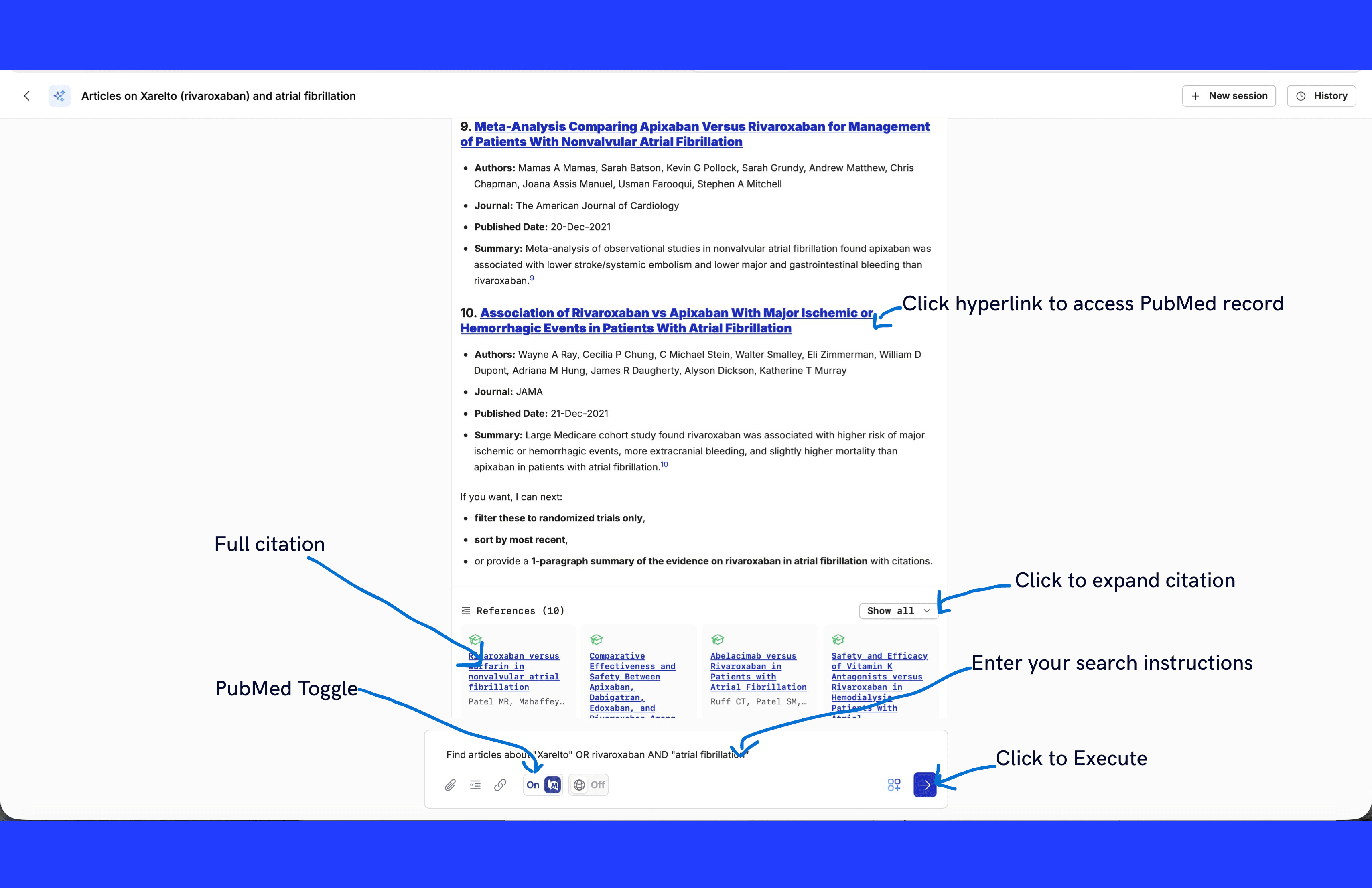
Search Examples
1. Find articles about "Xarelto" OR rivaroxaban AND "atrial fibrillation”
2. Find randomized studies that compare Rivaroxaban versus warfarin in nonvalvular atrial fibrillation
3. Find articles about renal impairment and Rivaroxaban
4. What is the safety and efficacy of using rivaroxaban in patients with renal failure?
a. Create a table comparing rivaroxaban vs apixaban vs warfarin in CKD
b. Create a visualization of the information in the summary table
Additional Actions
- Create a summary table of the search results
- Draft an article using the search results
- Create key takaways from the search results
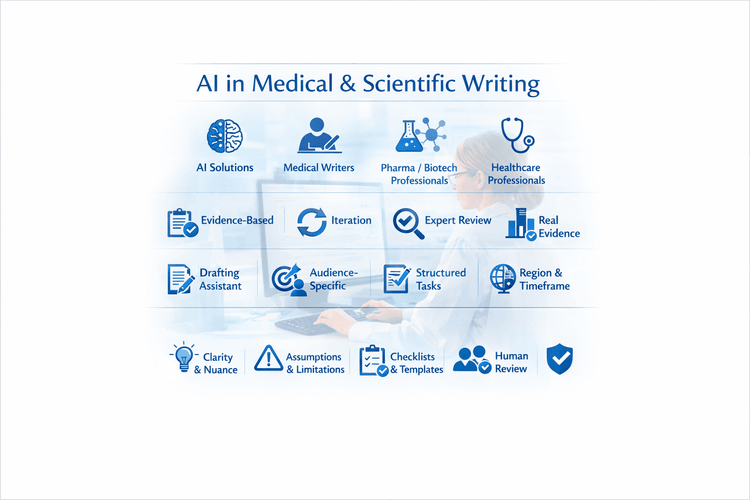
10 Tips For Using MACg and Other AI Solutions For Medical and Scientific Writing
This article shares 10 practical tips for medical writers, pharma/biotech professionals, HCPs, and researchers on how to use MACg and other AI solutions effectively and responsibly. It emphasizes that MACg's AI agent training knowledge is not a citable evidence base and must be anchored in real, verifiable sources such as publications, CSRs, labels, guidelines, and internal documents. Readers are encouraged to treat all AI outputs as Version 0.1, iterating with expert review rather than accepting the first draft. The article frames MACg as a drafting and thinking assistant, not an autonomous author, and stresses the importance of clear prompts about audience, purpose, region, timeframe, and scope. It recommends breaking complex projects into smaller tasks, using MACg to improve structure and clarity, and explicitly asking for limitations and caveats. Finally, it advocates creating institutional checklists and making expert human review and sign‑off mandatory for any impactful content.

Mar 1, 2026
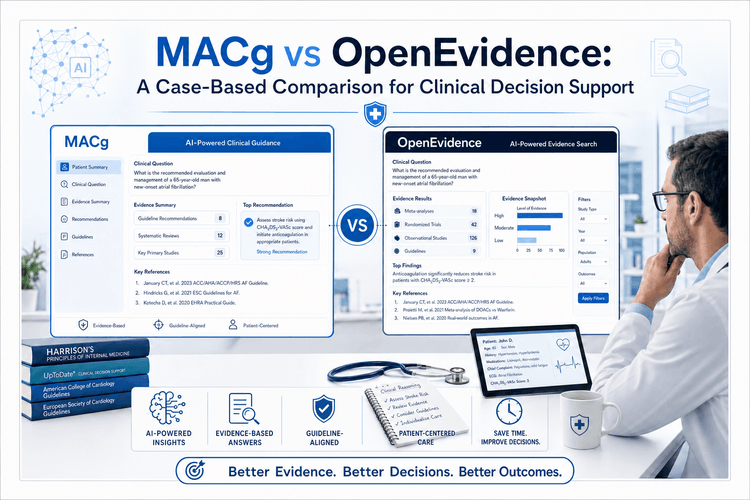
MACg vs OpenEvidence: A Case-Based Comparison for Clinical Decision Support
This is a case-based evaluation of MACg for clinical decision support using the same primary care scenarios previously used to assess OpenEvidence. Across five cases, MACg and OpenEvidence generally reached the same high-level clinical conclusions, but MACg consistently provided more specific, evidence-grounded, and operationally actionable recommendations. Its responses more often included treatment prioritization, dosing detail, monitoring considerations, alternative strategies, and case-specific reasoning. In one instance, MACg also identified an internal inconsistency in the case narrative. Overall, the evaluation suggests that MACg may offer added value by translating published evidence and guidelines into clearer, more practice-ready clinical recommendations.

Jun 14, 2026

AI Prompt Examples For Life Science Research And Writing
Here are ninety AI prompt templates for research and medical writing. Researchers, medical affairs, students, and healthcare professionals can use these prompts to create quality content using AI platforms.
Mar 12, 2025