10 Tips For Using MACg and Other AI Solutions For Medical and Scientific Writing
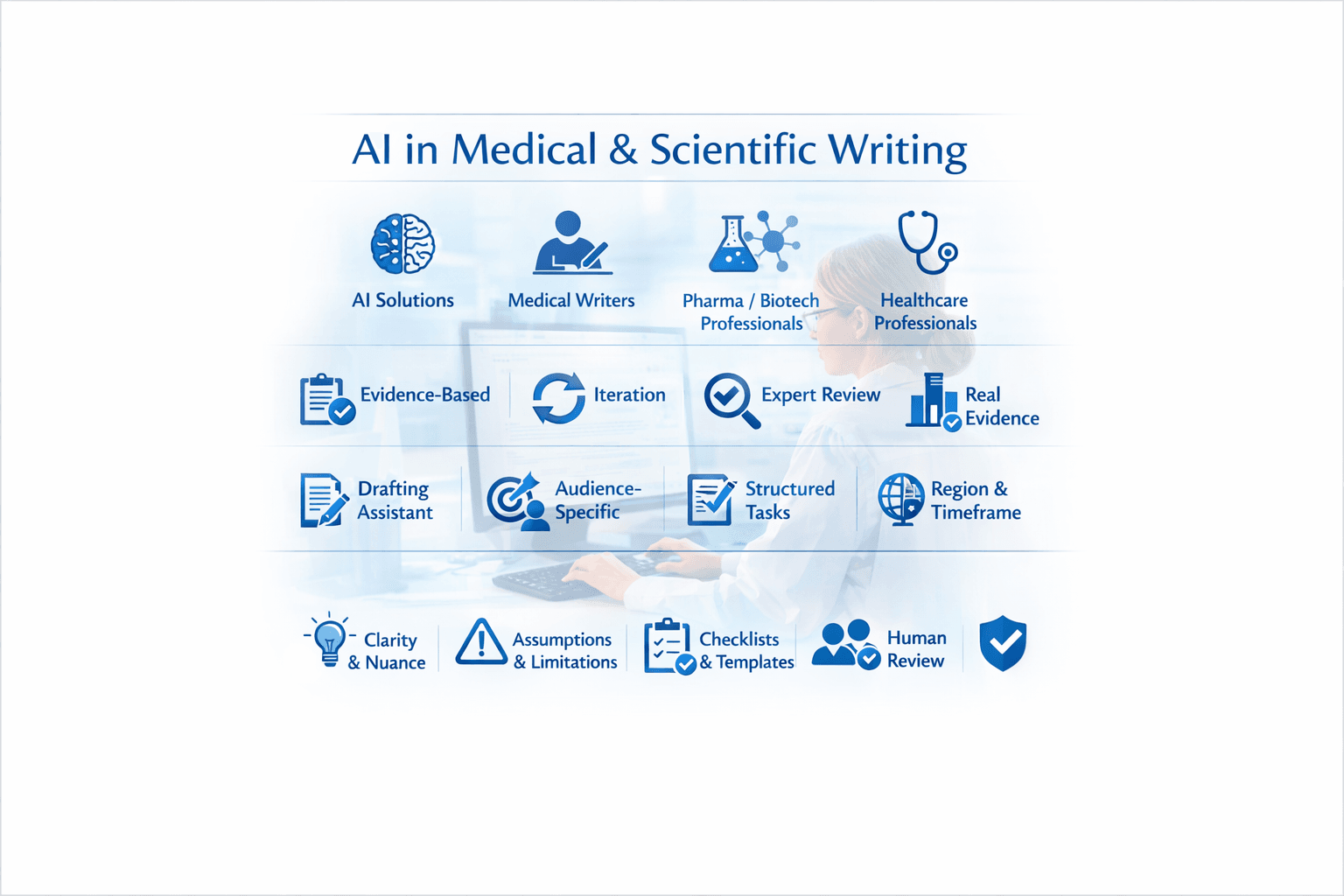
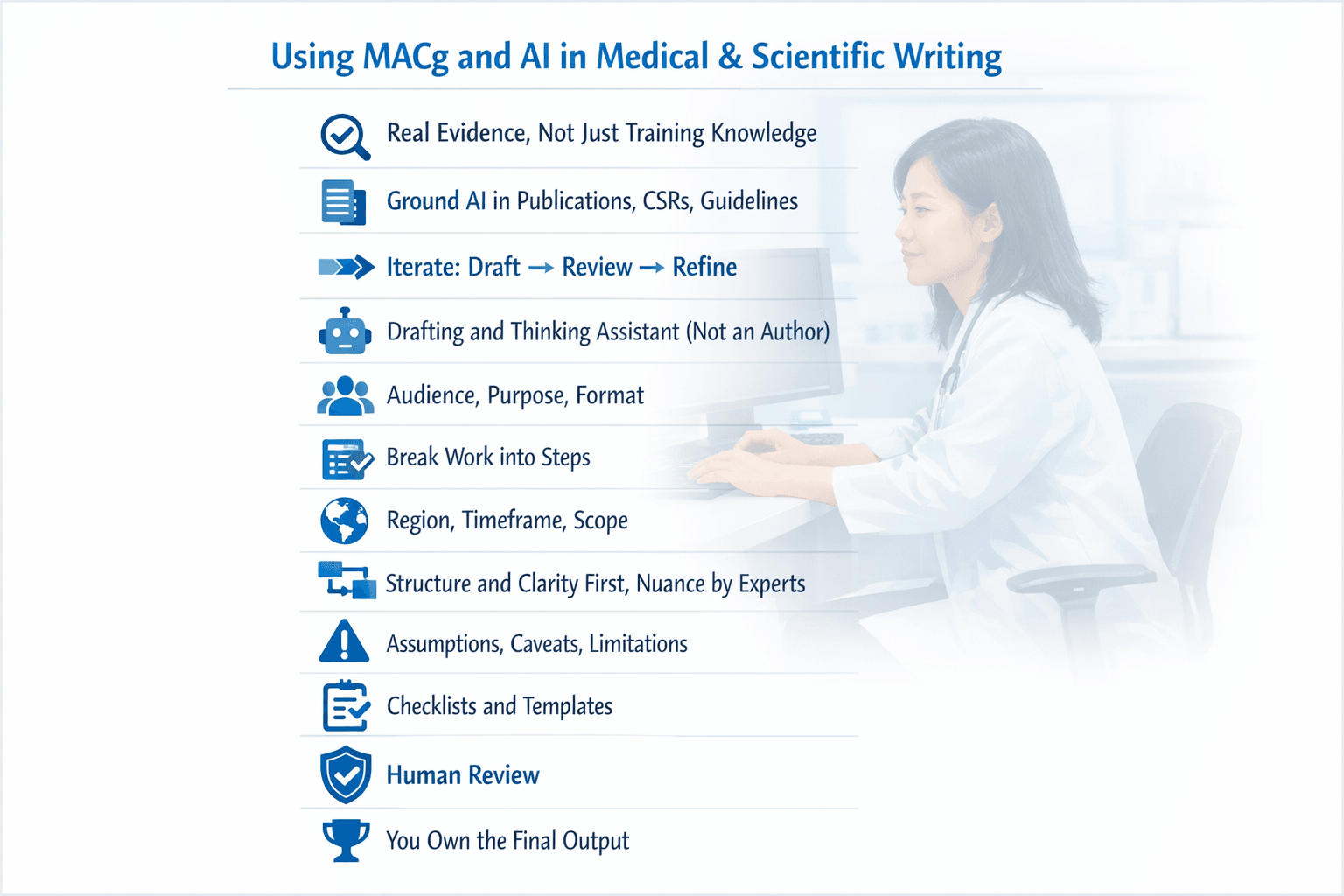
This article shares 10 practical tips for medical writers, pharma/biotech professionals, HCPs, and researchers on how to use MACg and other AI solutions effectively and responsibly. It emphasizes that MACg's AI agent training knowledge is not a citable evidence base and must be anchored in real, verifiable sources such as publications, CSRs, labels, guidelines, and internal documents. Readers are encouraged to treat all AI outputs as Version 0.1, iterating with expert review rather than accepting the first draft. The article frames MACg as a drafting and thinking assistant, not an autonomous author, and stresses the importance of clear prompts about audience, purpose, region, timeframe, and scope. It recommends breaking complex projects into smaller tasks, using MACg to improve structure and clarity, and explicitly asking for limitations and caveats. Finally, it advocates creating institutional checklists and making expert human review and sign‑off mandatory for any impactful content.
How To Get The Best Results From AI Platforms
For Medical Writers, Pharma/Biotech Professionals, HCPs, and Researchers
Introduction
MACg is designed to support high‑quality medical and scientific writing for:
- Medical writers and publications professionals
- Pharma/biotech teams (medical affairs, clinical development, safety, regulatory-facing roles)
- Healthcare professionals and clinicians
- Academic and industry researchers
- Students in healthcare disciplines
Scientists and medical professionals are trained to think in terms of evidence, accuracy, and accountability. AI solutions like MACg are designed to accelerate the creation of accurate, credible scientific content. However, if AI is not used correctly, generated responses can be inaccurate, incomplete, or low quality.
Two core pitfalls stand out:
Treating MACg's AI agent training knowledge as a citable evidence base.
Accepting the first response as “good enough” without iteration and expert review.
These 10 tips are essential for professionals whose outputs may end up in protocols, publications, regulatory interactions, training materials, or clinical decisions.
Tip 1: Don't Use AI Training Knowledge as a Knowledge Source – Ground MACg in Real Evidence
Why this is critical for regulated, evidence-based work
Whether you are:
—A medical writer drafting a manuscript
—A medical affairs professional preparing MSL resources
—A clinician considering a new therapy
—A researcher summarizing a body of literature
You need traceable, auditable sources.
MACg's AI agent training knowledge:
- Is not visible to users.
- Cannot be queried like a database.
- Cannot be used as a citable, inspectable evidence trail.
Problematic behavior users should avoid
A common mistake is skipping real evidence sources (attachments, PubMed, web search, internal documents) and immediately asking MACg to create “evidence‑grounded” content based only on the training knowledge of agents in MACg.
For example, prompts like these are not effective without appropriate knowledge sources:
- “List the clinical trials that support this safety conclusion.”
- “Confirm that this summary is consistent with the latest [cardiology/oncology/endocrinology] guideline.”
- “Give me references for these efficacy claims.”
- “Compare these clinical trials.”
These prompts assume that the agents in MACg can look back into their training corpus, pull out exact sources, and use them to create accurate, citable content. They cannot.
What to do instead
Use real, verifiable materials as the evidence backbone and let MACg work from those.
For medical writers and publications teams
Provide:
- Publications
- CSRs
- Conference posters
- Labels
Ask:
“Based only on these three uploaded phase 3 publications, create a comparative efficacy table focusing on primary and key secondary endpoints.”
“Draft a 250‑word Results section using only the uploaded CSR.”
For pharma/biotech medical affairs and commercial roles
Provide:
- Approved core claims documents
- Labels
- Internal scientific slide decks
Ask:
“From this label and core data deck, draft three MSL talking points on efficacy for [population].”
For clinicians and HCPs
Provide:
- Guidelines
- Key practice‑defining papers
Ask:
“Summarize the treatment algorithm from this guideline in 5–7 bullet points, focusing on first‑ and second‑line choices.”
For researchers
Provide:
- Protocols
- SAPs
- Pivotal publications
Ask:
“From this protocol, extract and tabulate primary and secondary endpoints with definitions.”
In all cases, MACg is processing your evidence using its advanced data extraction and chunking capabilities, not inventing content from opaque AI agent training knowledge.
Tip 2: Don't Stop After the First Response – Review, Refine, and Iterate
Why one-shot answers are dangerous for professionals
Across roles, first drafts often have gaps:
Medical writers:
Drafts may be verbose, misaligned with target journal style, or insufficiently cautious.
Pharma/biotech teams:
Outputs may stray beyond the label, mix global and regional perspectives, or overstate conclusions.
Clinicians/HCPs:
Summaries may omit key safety caveats, contraindications, or real‑world constraints.
Researchers:
Syntheses may gloss over methodological limitations or selectively emphasize results.
Treat every first output as Version 0.1. Some first drafts may be very strong if you provide a good prompt, but all outputs need expert review and refinement where necessary.
Here is a practical iterative pattern
1. Get a first pass
“Draft a 600‑word narrative describing the primary efficacy results of [trial] for an HCP audience.”
“Outline a 10‑slide deck for internal medical affairs training on [topic].”
2. Review with your expert lens
Ask yourself:
—Is it consistent with the underlying data and sources?
—Is the tone neutral, non‑promotional, and scientifically balanced?
—Does it reflect your institution's or company's position and approved messaging?
3. Refine with precise directions
—“Shorten to 350 words and remove any speculative language.”
—“Add a slide dedicated to limitations and real‑world applicability.”
—“Remove any content not directly supported by the uploaded CSR or label.”
4. Iterate as needed
—Two or three refinement cycles are normal in professional use.
—Each cycle should move the draft closer to your desired standard.
—Don't give up after a disappointing first draft
Sometimes professionals stop using AI if the first draft is not exactly what they want and conclude that “AI is not helpful.” This is also a mistake.
With:
—The correct knowledge sources (attachments, PubMed/web, internal docs)
—Detailed, targeted instructions
—A few iterations
MACg becomes an extremely powerful platform for authoring many types of content, often faster and more consistently than purely manual drafting.
In regulated environments, think of MACg as generating drafts for your editorial and scientific judgment, not finished products.
Tip 3: Treat MACg as a Drafting and Thinking Assistant, Not an Autonomous Author
For medical writers and publications professionals
MACg can:
—Generate first drafts of sections (Background, Rationale, Methods, and Results).
—Propose alternative phrasings to tighten language and improve clarity.
—Suggest structures for manuscripts, abstracts, or posters.
But:
Authorship criteria and editorial policies require substantive intellectual contribution and accountability from humans.
MACg (and the agents within it) must not be credited as an author; it is a tool, not a responsible party.
For pharma/biotech teams
Use MACg to:
- Sketch out training content (MSL decks, internal FAQs).
- Generate scenario‑based questions for role‑plays.
- Help structure scientific narratives for advisory boards or internal meetings.
Then ensure:
- Alignment with label, local regulations, and internal scientific/medical positions.
- Clear separation between AI‑assisted drafts and approved, final content.
For clinicians and researchers
Use MACg to:
—Draft notes, summaries, and patient education materials (always to be reviewed before use).
—Brainstorm alternative hypotheses, study designs, or discussion angles.
—Support review of the medical and scientific literature (e.g., structuring summaries, identifying themes).
In every role, MACg is there to accelerate your thinking and drafting, not to replace your expertise, judgment, or responsibility.
Tip 4: Be Explicit About Audience, Purpose, and Format in Every Prompt
Tailoring by audience
You often write for very different audiences:
- Specialists vs generalists
- Internal vs external
- HCPs vs patients vs payers vs regulators
Tell MACg exactly which audience you have in mind:
—“Write for experienced oncologists.”
—“Write for internal medical affairs colleagues with clinical backgrounds.”
—“Write for primary care physicians not specialized in endocrinology.”
—“Write for patients newly diagnosed with [condition].”
Clarify the purpose and format
Be explicit about why and how the content will be used.
Purpose:
- Journal article
- Conference abstract
- Internal training
- Patient education
- Payer briefing
- Regulatory Q&A support
Format:
- Bullet‑point slide content
- Structured abstract
- One‑page narrative summary
- FAQ list
- Email briefing
Here is an example.
Instead of:
“Summarize this study.”
Use:
“Summarize this phase 3 oncology study in 300–350 words for an internal medical affairs newsletter, using headings for Background, Methods, Results, and Key Clinical Implications.”
The more precise you are about audience, purpose, and format, the less rewriting you'll need later.
Tip 5: Break Complex Projects Into Smaller, Sequential Tasks
For medical writers and publications
Instead of:
“Write a full manuscript from these documents.”
Use a stepwise sequence:
—“List all key messages that emerge from these three uploaded studies.”
—“Propose 2–3 possible manuscript structures (IMRAD) to convey these messages to oncologists.”
—“Draft a detailed outline with section‑level bullets.”
—“Draft only the Introduction section (600–800 words) based on the outline, keeping a neutral scientific tone.”
For pharma/biotech and medical affairs
Instead of:
“Create a full MSL training deck on [drug] in [indication].”
Try:
—“List 10–15 questions an HCP might ask an MSL about [drug] in [indication].”
—“Map which uploaded documents answer each question.”
—“Propose a 12‑slide structure for an internal MSL training deck.”
—“Draft bullets for slides 1–4 only.”
For clinicians and researchers
Instead of:
“Summarize everything we know about [disease] and [therapy].”
Use:
—“List the main domains of evidence needed: pathophysiology, clinical outcomes, safety, special populations, etc.”
—“For each domain, outline the 3–5 key points based on the uploaded materials.”
—“Expand just the safety section into a 400‑word narrative for HCPs.”
This segmented approach makes review, correction, and approval far more manageable and keeps each step tightly connected to the underlying evidence.
Tip 6: Specify Region, Timeframe, and Scope to Manage Relevance
Why this matters for professionals
—Regulatory status, guidelines, and standard of care differ across regions.
—MACg's AI agent training knowledge has a time horizon, and newer data or approvals may not be reflected unless you supply the evidence.
The more detail you provide, the more likely the draft will be close to your expectations.
How to instruct MACg
Include constraints like:
Region
—“Assume a US clinical and regulatory context (FDA approvals).”
—“Focus on EMA approvals and European guidelines.”
Timeframe
“Limit discussion to evidence available up to early 2024.”
“Do not speculate on pipeline agents or unpublished data.”
Scope
—“Discuss only adult patients with [condition], exclude pediatrics and pregnancy.”
—“Focus on phase 3 RCT data, not preclinical or phase 1/2.”
This is especially important if you are:
—Preparing payer or health technology assessment (HTA) materials
—Supporting labeling discussions
—Working in global vs local medical affairs where regional differences matter
Tip 7: Use MACg to Improve Structure and Clarity, Then Add Nuance Yourself
For medical writers
MACg is ideal for:
- Converting rough bullet notes into structured paragraphs (or vice versa).
- Turning overlapping text from multiple sources into a single coherent narrative.
- Cleaning language in drafts from non‑native English speakers.
You then add:
—Journal‑specific style and formatting nuances.
—Detailed interpretation and positioning of results.
—Alignment with the broader publication strategy.
For pharma/biotech, HCPs, and researchers
Use MACg to:
- Turn meeting notes into clear summaries or action lists.
- Reformat data into tables for internal discussions.
- Generate lay or semi‑technical explanations of complex mechanisms.
You then:
—Insert company or institutional stance.
—Add real‑world practice context (access issues, local logistics, standard of care).
—Ensure messaging is accurate, balanced, and compliant with internal and external standards.
Tip 8: Ask MACg to Surface Assumptions, Caveats, and Limitations
Making AI part of your critical appraisal
Regardless of your role, you are trained to ask:
- “What are the limitations?”
- “What might bias these results?”
- “How might this differ in real‑world practice?”
You can explicitly ask MACg to articulate these concerns:
—“List methodological limitations that might affect the interpretation of these results.”
—“Provide possible reasons why real‑world outcomes might differ from the trial outcomes in typical clinical practice.”
“Generate potential critical questions a reviewer, regulator, or KOL might raise about this dataset.”
Where this helps
This is valuable for:
Manuscript discussion sections
MSL objection‑handling and Q&A preparation
Protocol and study design optimization
Preparing for tough Q&A in clinical, regulatory, or HTA forums
By asking MACg to surface caveats and alternative viewpoints, you turn it into a critical thinking partner, not just a drafting engine.
Tip 9: Create and Reuse Checklists and Templates as Guardrails
Building institutional consistency
For teams in:
- Medical writing and publications
- Medical affairs and commercial
- Clinical development and research
- Clinical care and education
You can use MACg to standardize your approach and reduce variability in how AI is used.
Examples:
Medical writing
“Create a checklist for finalizing a manuscript written with AI assistance (accuracy checks, data consistency, authorship, ethics, journal policies).”
Medical affairs/pharma
“Draft a standard MSL response template: background, key messages, evidence summary, safety, limitations, and references (to be populated manually).”
Clinicians/HCPs
“Create a checklist for verifying AI‑generated patient education material before giving it to patients.”
Researchers
“Build a protocol‑writing checklist: endpoints, populations, inclusion/exclusion criteria, statistical plan, safety monitoring.”
Once created:
—Customize them for your organization.
—Approve them through an appropriate internal review.
Use them as reusable frameworks for future MACg sessions, improving consistency and oversight over time.
Tip 10: Make Expert Human Review and Sign-Off Mandatory
Professional responsibility cannot be delegated to a tool.
Across all roles:
- Medical writers must ensure accuracy and adherence to source data and journal requirements.
- Pharma/biotech professionals must comply with regulatory, legal, and ethical standards.
- Clinicians and HCPs must put patient safety and evidence‑based practice first.
- Researchers must protect scientific integrity and reproducibility.
MACg is a platform; it cannot assume responsibility
Build a structured review pathway for any output that may influence:
—Patient care
—Regulatory interactions
—Publications or external communications
—Internal decisions with significant consequences
Ensure:
—AI‑assisted drafting using clear prompts and appropriate, high‑quality sources (documents, PubMed/web, internal data).
—Scientific and clinical review by qualified experts.
—Compliance / regulatory/legal review, where applicable.
—Final human sign‑off, with named responsibility.
AI can speed up your work, but you own the final content.
Closing Thoughts
For medical writers, pharma/biotech professionals, healthcare professionals, and researchers, MACg can:
—Accelerate drafting
—Turbocharge literature search and analysis
—Clarify complex topics
—Support structured thinking and communication
when used with the same rigor you apply to everything else in medicine and science.
—Do not rely on MACg's AI agent training knowledge as your evidence base.
—Do not accept the first answer as final.
—Do use MACg to organize, clarify, and brainstorm while grounding everything in real, verifiable data and expert human judgment.
Do not quit using MACg if the first try does not meet your expectations. Improve your prompt, attach or reference solid evidence, iterate, learn how the platform works, shape the outcome, and own it.
Applying the tips in this article and approaching AI solutions as powerful, complementary tools that enhance your expertise, while always owning the final output, is the path to successfully and responsibly using these amazing technologies in medical and scientific work.
From Evidence to Publication-Ready Content—Faster
MACg brings research, writing, citations, visuals, and presentations together in one Evidence-First AI workspace.
Reliability of MACg for Source‑Aligned Clinical‑Trial Data Extraction: Hallucination, Accuracy, and Contextual Understanding
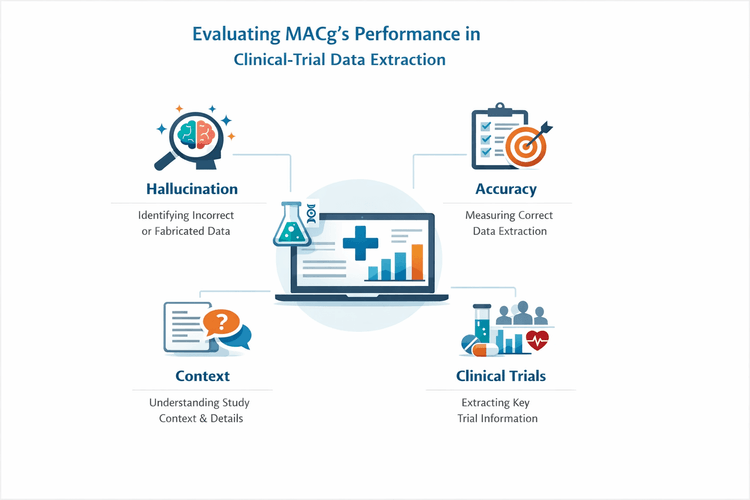
We evaluated MACg, a GPT–5–based writing and research assistant, for medical writing and data extraction, on five uploaded clinical‑trial PDFs (15 questions per study; 75 total). Questions on design, endpoints, efficacy, safety, limitations, and interpretation were asked one at a time, without instructions to avoid hallucinations or rely on the document. A clinician compared each answer with the source. MACg demonstrated zero hallucinations, 100% accuracy for requested data, contextual integration across sections, appropriate handling of missing information, and clinically coherent interpretation grounded in the trials, supporting its use for reliable, source‑aligned medical communication.

Feb 14, 2026
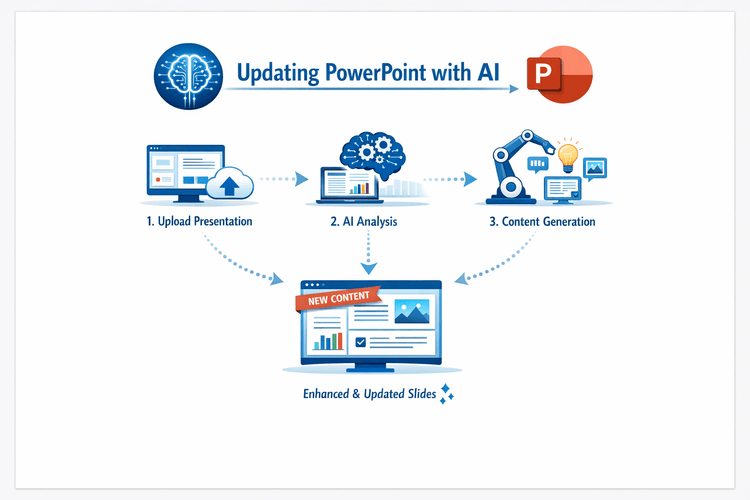
How to Use AI to Update PowerPoint Presentations (Step-by-Step Guide for Faster, Better Slides)
Updating an existing PowerPoint deck no longer has to mean hours of manual rewriting and reformatting. This article shows a practical, step‑by‑step workflow for using AI (e.g., MACg) to generate new, evidence‑based slides and seamlessly integrate them into your current presentation. Instead of asking AI to “fix” an entire deck, you'll learn how to target specific sections, brief the AI with the right sources, generate PowerPoint‑ready slides, and then merge and restyle them so they match your original look and feel. The result is faster updates, higher consistency, and full human control over scientific quality.

Jan 5, 2026
100 AI Slide Presentation Prompts for Busy Medical and Scientific Professionals
This article provides 100 ready‑to‑use AI prompts to help medical and scientific professionals create high‑quality slide presentations with MACg. The prompts are organized into practical categories, including clinical education, drug and mechanism‑of‑action decks, PubMed‑driven evidence reviews, specialty teaching, medical affairs and HEOR, training and curriculum, data‑visualization, and conference or grant presentations. Each prompt uses clear “Instruction:” wording and customizable placeholders (e.g., [condition], [audience], [timeframe]) so users can quickly adapt them to their specific topic and setting. By removing blank‑slide paralysis, the collection speeds up evidence‑based slide creation while supporting consistent, structured, and compliant communication.
Feb 4, 2026

How CME Writers Can Use AI Responsibly Without Losing Their Critical Role
Generative AI is reshaping continuing medical education (CME) writing, but it won't replace medical writers—it will empower those who learn to use it as a collaborative partner. AI excels at summarizing literature, structuring content, and sparking creative ideas, yet it lacks the judgment, ethical reasoning, and contextual insight required for high‑stakes medical education. Human writers remain essential for accuracy, compliance, bias detection, and learner-centered design. Tools like MACg, built specifically for medical writers, model responsible human–AI collaboration by securing data, integrating PubMed, managing citations, and lightening mechanical tasks so writers can focus on synthesis, equity, and meaningful engagement.

Feb 12, 2026
AINGENS Launches A Generous Affiliate Program for MACg, The Cutting-Edge AI Platform for Life Sciences Content Creation
AINGENS, a leader in AI-driven research and medical writing innovation, announces an affiliate program for its flagship product, MACg. The program offers an attractive 30% recurring commission. The press release highlights MACg's advanced features, including AI multimodal writing assistance powered by GPT-4.0 and o3-mini, real-time integration with PubMed, automated citation support, and robust visualization tools. Additionally, MACg boasts an enterprise-grade security framework that ensures data privacy and GDPR compliance. This comprehensive announcement also emphasizes AINGENS' focus on empowering teams with fit-for-purpose AI solutions that streamline and enhance life sciences workflows, enabling users to achieve unprecedented productivity in scientific content creation. This initiative underscores AINGENS' dedication to innovation in scientific research and content creation.
Jun 26, 2025