OpenEvidence vs MACg: A Review for Healthcare Professionals Evaluating AI Tools for Literature Search, Medical Information, and Scientific Content Workflows
This article compares OpenEvidence and MACg for healthcare professionals evaluating tools for literature search, medical information, and scientific content creation. The two platforms serve different workflow needs. OpenEvidence provides rapid, evidence-based clinical question support, while MACg supports end-to-end scientific workflows that extend beyond answer retrieval. MACg supports PubMed and web search, user-uploaded files, scientific writing, citation management, reference organization, slide generation, charts, figures, and visual content creation within one workspace. MACg is a more comprehensive platform for teams that need to move from evidence discovery to polished scientific deliverables efficiently.
Executive Summary
Healthcare professionals and life sciences teams need platforms that do more than return an answer. They need tools that can find evidence, support literature review, enable medical information development, generate scientific content, manage references, create presentations and visuals, and preserve traceability across the workflow.
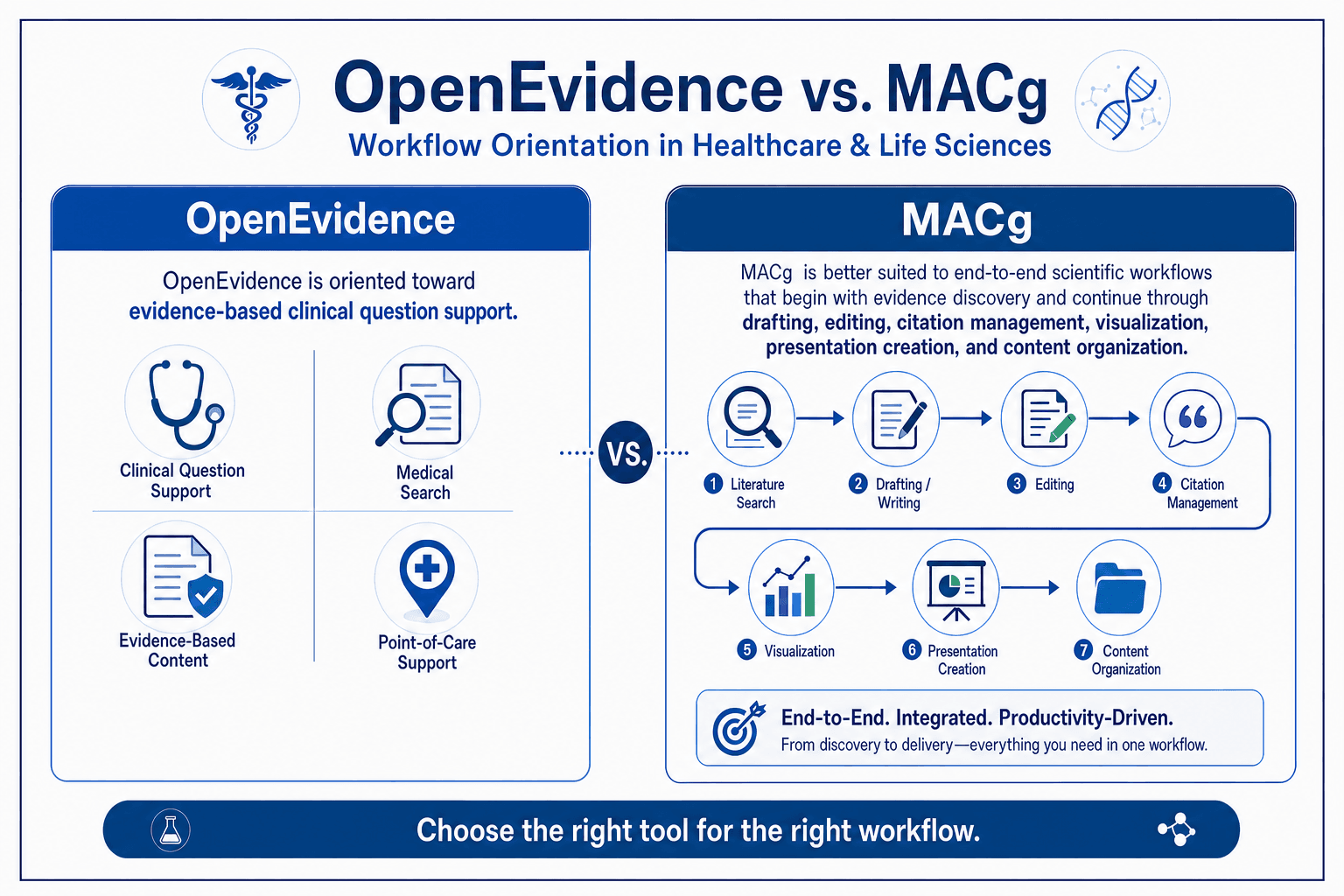
OpenEvidence and MACg serve different roles within that landscape. OpenEvidence is oriented toward evidence-based clinical question support, while MACg is better suited to evidence-first end-to-end scientific workflows that begin with evidence discovery and continue through drafting, editing, citation management, visualization, presentation creation, and content organization.
A key distinction is source access and search flexibility. OpenEvidence content includes material from its partners, including full-text clinical findings, figures, tables, and multimedia from NEJM Group publications rather than literature databases or internet search functionality.
By contrast, MACg allows users to search PubMed, use web search, or start from their own files, enabling workflows that cover both indexed biomedical literature and non-PubMed materials such as prescribing information and other web-based medical content.
Selecting the Right Platform for Scientific Workflows
This comparison is written for healthcare professionals, medical affairs teams, medical information specialists, researchers, scientific communications teams, and life sciences organizations evaluating which platform is better aligned with their needs in:
- Literature search and evidence discovery
- Medical information and evidence-grounded response development
- Scientific writing, review, and content creation
- Slides, charts, figures, and presentation assets
- Citation management and traceable workflow execution
The central question is not which tool provides fast answers. The more important question is which tool best supports the complete scientific workflow required in healthcare and life sciences environments.
Why Complete Workflow Support Matters
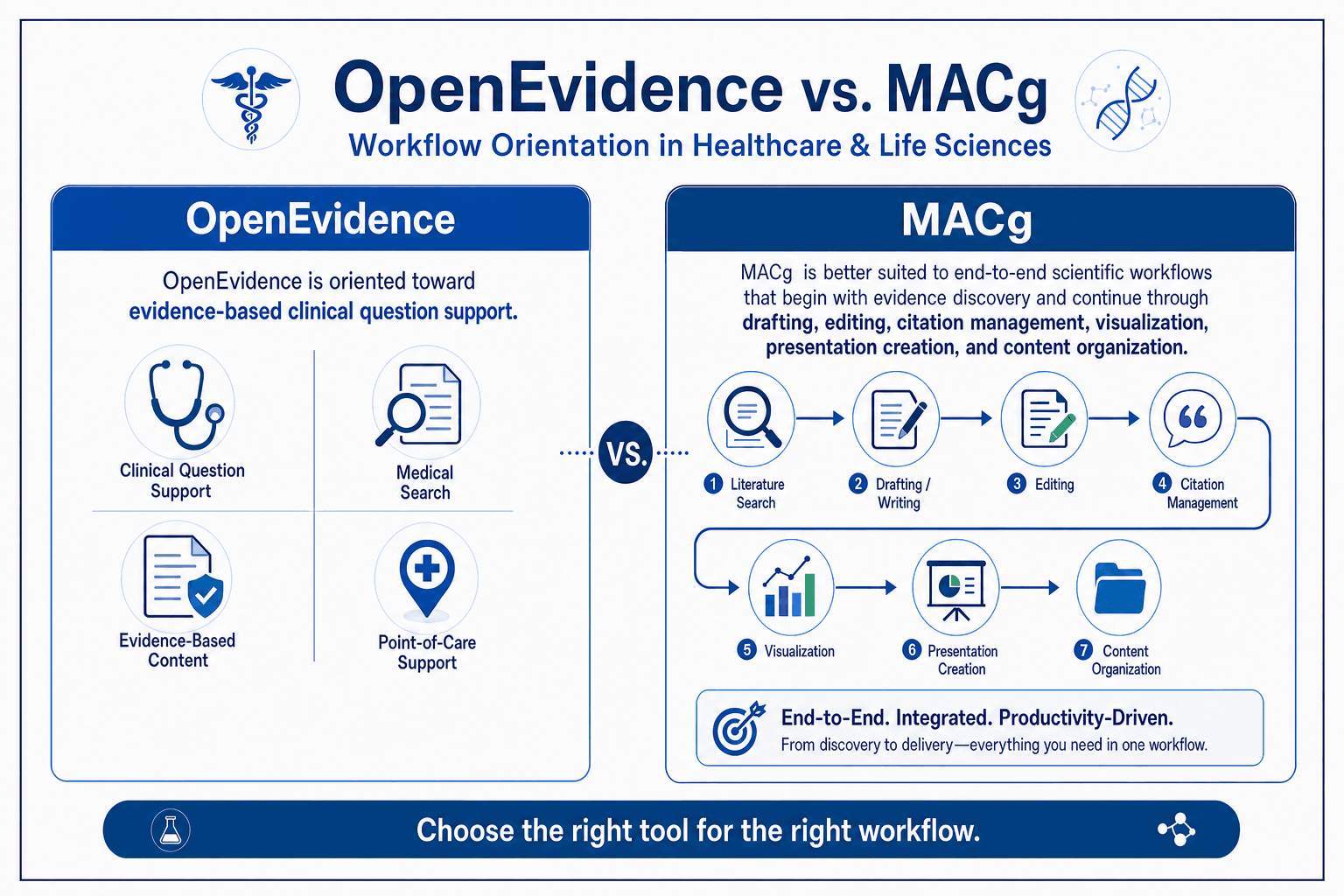
In scientific and medical environments, literature retrieval is usually only the first step. Teams often need to:
- identify relevant evidence;
- review and synthesize multiple sources
- prepare medical information letters and responses
- draft FAQs, abstracts, papers, posters, grant proposals, and study reports
- build MSL, ad board, CME, or congress slide decks
- create charts, diagrams, and visuals
- manage references and bibliographies
- retain organization and traceability across multiple deliverables
A retrieval-focused tool can be useful in point-of-care support. However, scientific teams require a connected system that supports the full path from evidence intake to final output.
Source Access and Literature Search Scope
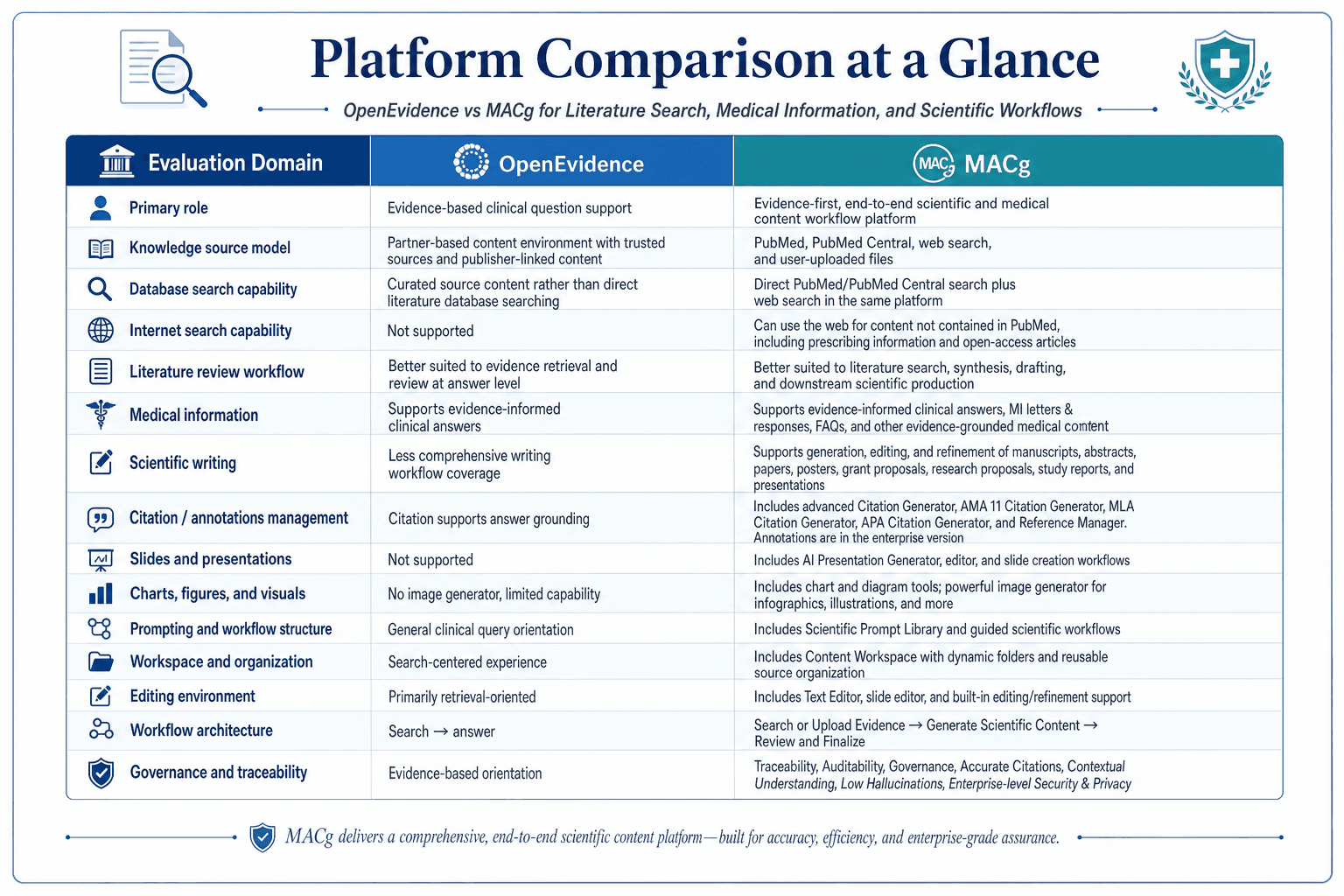
One of the most important practical differences between the two platforms is the scope of searchable content. OpenEvidence includes content from strategic content partners like NEJM Group publications and others. This is different from a platform that functions as a direct search layer over large medical literature databases or the broader web.
In contrast, MACg supports integrated PubMed and web search, and users can also work from their own trusted files. Its workflow explicitly begins with “Use PubMed, web search, or your own files to start with trusted sources.”
This distinction matters operationally. PubMed gives access to a very large biomedical literature universe, while web search extends reach to materials that may not be indexed in PubMed, including prescribing information and other non-PubMed medical content. That makes MACg more flexible for teams whose evidence needs go beyond limited journal-derived clinical answer support.
Why MACg Is Better Suited for Scientific Workflows
1. Integrated Literature Search Across Multiple Source Types
MACg allows users to begin from PubMed, web search, or their own files, which is a materially broader evidence intake model for scientific teams.
This matters because healthcare and life sciences workflows often require:
- peer-reviewed literature from PubMed
- full-text or public articles indexed through PubMed-related ecosystems
- web-based scientific or medical content
- non-journal assets such as prescribing information
- internal source packs or uploaded documents
A platform that can accommodate all of these inputs is better suited to real-world scientific work than one centered mainly on a partner-content answer environment.
2. Ask MACg as a Multimodal Scientific Assistant
MACg includes Ask MACg, a multimodal AI assistant and agents for scientific research and content creation. This is important because scientific workflows require more than search. Users need to synthesize, compare, refine, summarize, rewrite, and adapt evidence into different output formats for different audiences.
That multimodal assistant model supports a continuous workflow from question to draft to refined deliverable.
3. Purpose-Built Scientific Writing
MACg supports scientific writing across a wide set of healthcare and life sciences deliverables. Examples include:
- manuscripts
- abstracts
- papers
- posters
- grant proposals
- research proposals
- study reports
- medical information
- presentations
- infographics
- educational materials
This breadth is a major differentiator for teams whose work product must be publication-style, presentation-ready, or organizationally reviewable.
4. Strong Fit for Medical Information & Communication Teams
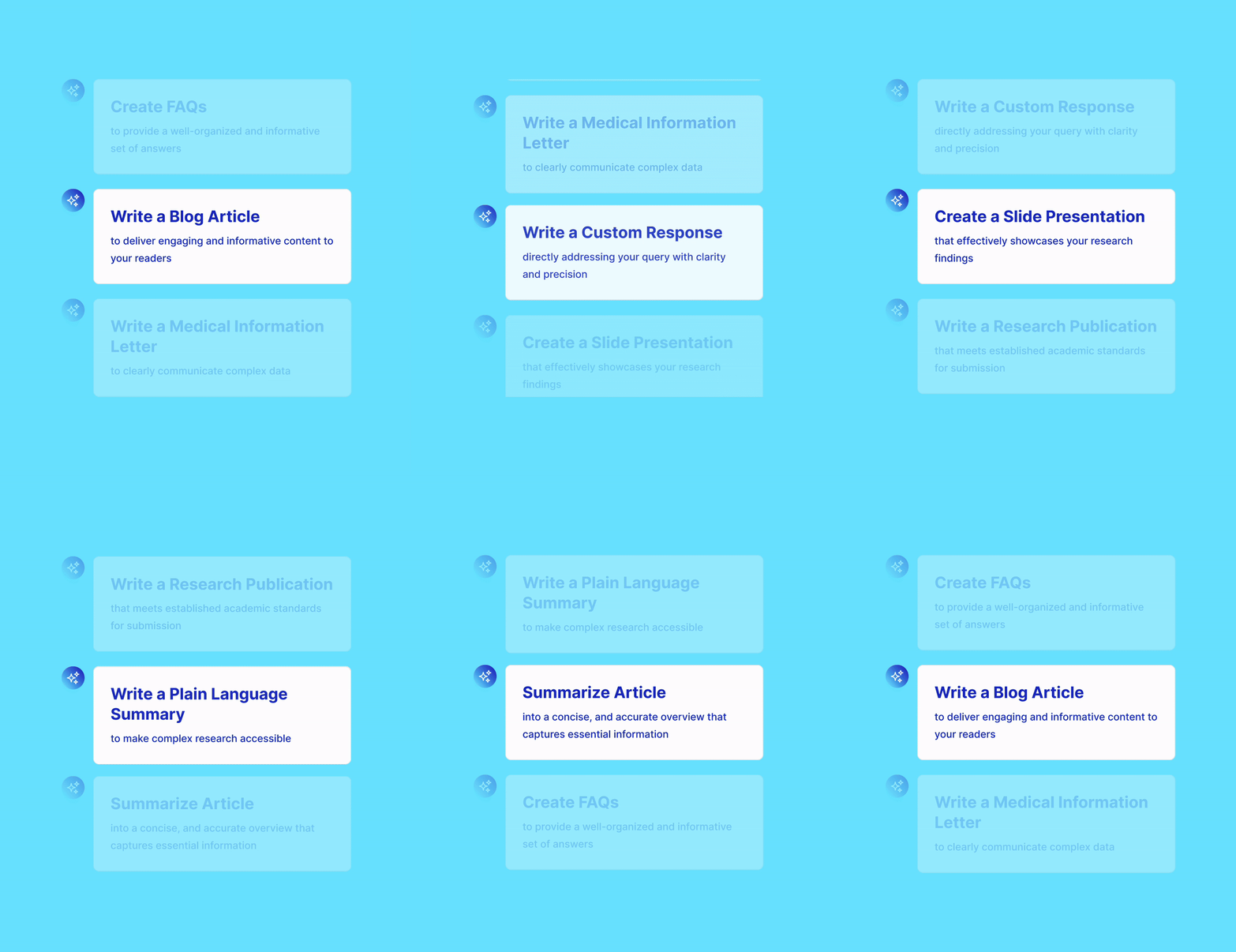
MACg supports creation of MI letters & responses, FAQs, MSL & Adboard slide decks, infographics, and training materials.
That combination is especially important in medical information, where the workflow is not just “find the answer,” but also:
- structure the response
- support it with evidence
- prepare derivative materials for field or internal use
- retain traceability to sources
5. End-to-End Citation and Reference Management
MACg includes:
- A proprietary Citation Generator that supports AMA 11, MLA, and APA Citation formats
- Reference Manager
It also supports integration of PubMed references directly into documents, helping users pull, cite, store, and manage references in one platform. For scientific writers and medical communicators, this is a substantial workflow advantage because citation handling is often one of the most time-intensive steps in evidence-based authoring.
6. Slides and Presentation Creation
MACg has an AI Presentation Generator that includes a slide builder and slide editor. It supports creation of editable slides and presentation-ready scientific slide decks.
This is highly relevant for:
- congress materials
- field medical decks
- medical education
- ad board content
- P&T presentations
- internal scientific briefings
- grand rounds
- thesis defense
- business presentation
Rather than stopping at evidence retrieval, MACg supports conversion of evidence into presentation assets. It can draft 100 slides in minutes.
7. Charts, Figures, and Visual Scientific Communication
MACg includes Charts & Figures as well as Image/Diagram/Chart tools. These capabilities are important because scientific communication often requires data visualization, mechanism diagrams, patient-flow displays, and infographic-style summaries.
Keeping visual creation inside the same platform reduces the need to use disconnected tools and improves continuity between evidence retrieval and final visuals.
8. Scientific Prompt Library and Guided Workflows
MACg includes a Scientific Prompt Library and purpose-built prompts for common medical affairs and scientific tasks. The slide library is customizable for enterprise clients.
This is useful for organizations that want:
- more consistent outputs across users
- repeatable content generation pattern
- quicker onboarding for teams
- structured prompting for complex scientific tasks
9. Content Workspace and Source Reuse
The Content Workspace lets users organize projects, documents, and research with dynamic folders, and to organize and reuse sources.
This is especially valuable in scientific operations, where teams often need to build multiple outputs from shared evidence sets and preserve continuity across projects.
10. Built-in Editing and Refinement
MACg includes a full Text Editor and slide editor for refining content. Scientific writing is iterative by nature, and the ability to edit and refine within the same platform supports more efficient authoring and review.
11. Governance, Accuracy, and Enterprise Controls
MACg exhibits low hallucinations, high accuracy, and it says when it does not have enough information to respond accurately instead of fabricating information. It also exhibits conservative behavior.
MACg has traceability, auditability, and governance features built in:
- Contextual Understanding
- Accurate Citations
- Advanced AI Agents
- Enterprise-level Security | Privacy
These capabilities matter in healthcare and life sciences because teams need defensibility, oversight, and source-grounded outputs in addition to speed.
Conclusion
OpenEvidence rapidly surfaces evidence-based clinical answers from their trusted-partner content. However, users should be aware of the limitations of this approach and use additional sources if a thorough review of the topic is required.
MACg supports evidence-first workflows that require searching medical literature databases, accessing web-based content outside PubMed, drafting medical information and scientific content, managing references, building visuals and presentations, and organizing evidence-driven projects inside a governed workspace. It addresses the inefficiency and cost of using multiple platforms by letting professionals turn evidence into scientific work products on one platform, with traceability, auditability, and governance.
Workflow scope is the defining distinction for healthcare professionals evaluating platforms for literature search, medical information, and scientific content creation.
From Evidence to Publication-Ready Content—Faster
MACg brings research, writing, citations, visuals, and presentations together in one Evidence-First AI workspace.
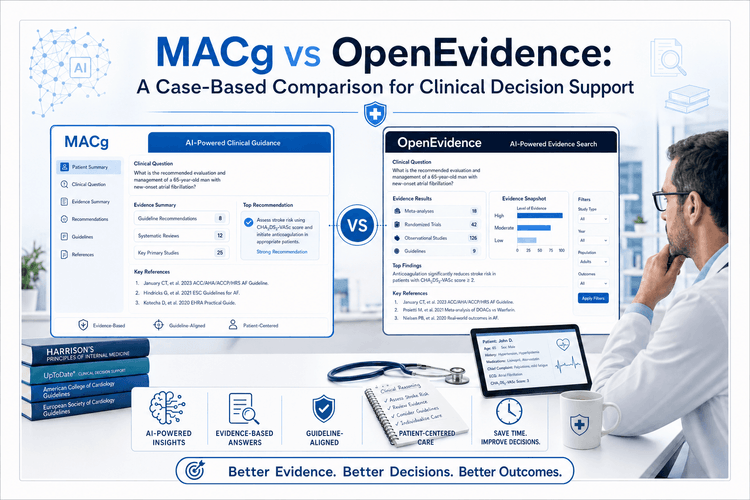
MACg vs OpenEvidence: A Case-Based Comparison for Clinical Decision Support
This is a case-based evaluation of MACg for clinical decision support using the same primary care scenarios previously used to assess OpenEvidence. Across five cases, MACg and OpenEvidence generally reached the same high-level clinical conclusions, but MACg consistently provided more specific, evidence-grounded, and operationally actionable recommendations. Its responses more often included treatment prioritization, dosing detail, monitoring considerations, alternative strategies, and case-specific reasoning. In one instance, MACg also identified an internal inconsistency in the case narrative. Overall, the evaluation suggests that MACg may offer added value by translating published evidence and guidelines into clearer, more practice-ready clinical recommendations.

Jun 14, 2026

How CME Writers Can Use AI Responsibly Without Losing Their Critical Role
Generative AI is reshaping continuing medical education (CME) writing, but it won't replace medical writers—it will empower those who learn to use it as a collaborative partner. AI excels at summarizing literature, structuring content, and sparking creative ideas, yet it lacks the judgment, ethical reasoning, and contextual insight required for high‑stakes medical education. Human writers remain essential for accuracy, compliance, bias detection, and learner-centered design. Tools like MACg, built specifically for medical writers, model responsible human–AI collaboration by securing data, integrating PubMed, managing citations, and lightening mechanical tasks so writers can focus on synthesis, equity, and meaningful engagement.

Feb 12, 2026
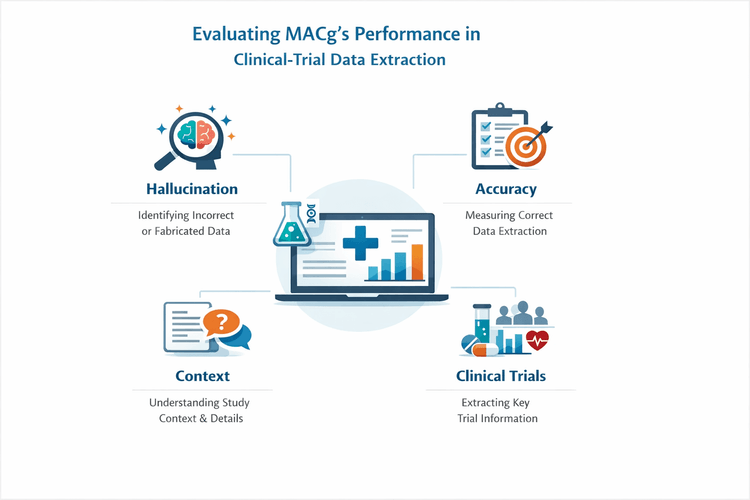
Reliability of MACg for Source‑Aligned Clinical‑Trial Data Extraction: Hallucination, Accuracy, and Contextual Understanding
We evaluated MACg, a GPT–5–based writing and research assistant, for medical writing and data extraction, on five uploaded clinical‑trial PDFs (15 questions per study; 75 total). Questions on design, endpoints, efficacy, safety, limitations, and interpretation were asked one at a time, without instructions to avoid hallucinations or rely on the document. A clinician compared each answer with the source. MACg demonstrated zero hallucinations, 100% accuracy for requested data, contextual integration across sections, appropriate handling of missing information, and clinically coherent interpretation grounded in the trials, supporting its use for reliable, source‑aligned medical communication.
Feb 14, 2026