Preventing AI Hallucinations in Medical Content: Practical Tips for Medical Writers and Clinicians
AI hallucinations in medical content are plausible-sounding but inaccurate, unsupported, or fabricated outputs. The article provides practical tips for medical writers and clinicians to reduce the risk of a hallucinations and increase accuracy in AI outputs. These failures happen because large language models are optimized to generate likely text, not to verify truth. Risk increases when models answer without access to curated evidence, while retrieval-augmented generation can improve grounding by linking outputs to external sources, though it does not eliminate error. To reduce risk, the article recommends an evidence-first workflow: start with trusted source material, constrain the model to that material, and require human review before content is used. It also emphasizes choosing the right platform, structured prompting, manual verification of references, preservation of uncertainty, and privacy-conscious use in clinical settings.
I. Introduction
AI hallucinations are outputs that sound credible but are false, unsupported, misleading, or fabricated. In medical writing, this can mean invented citations, inaccurate evidence summaries, unsupported treatment claims, or confident language that lacks reference support.
These failures are dangerous in patient education, where errors can shape health behavior; in clinician-facing educational materials, where flawed summaries may influence practice; in regulatory or scientific writing, where precision and traceability are essential; and in clinical documentation, where inaccuracies can taint the medical record and affect patient care.
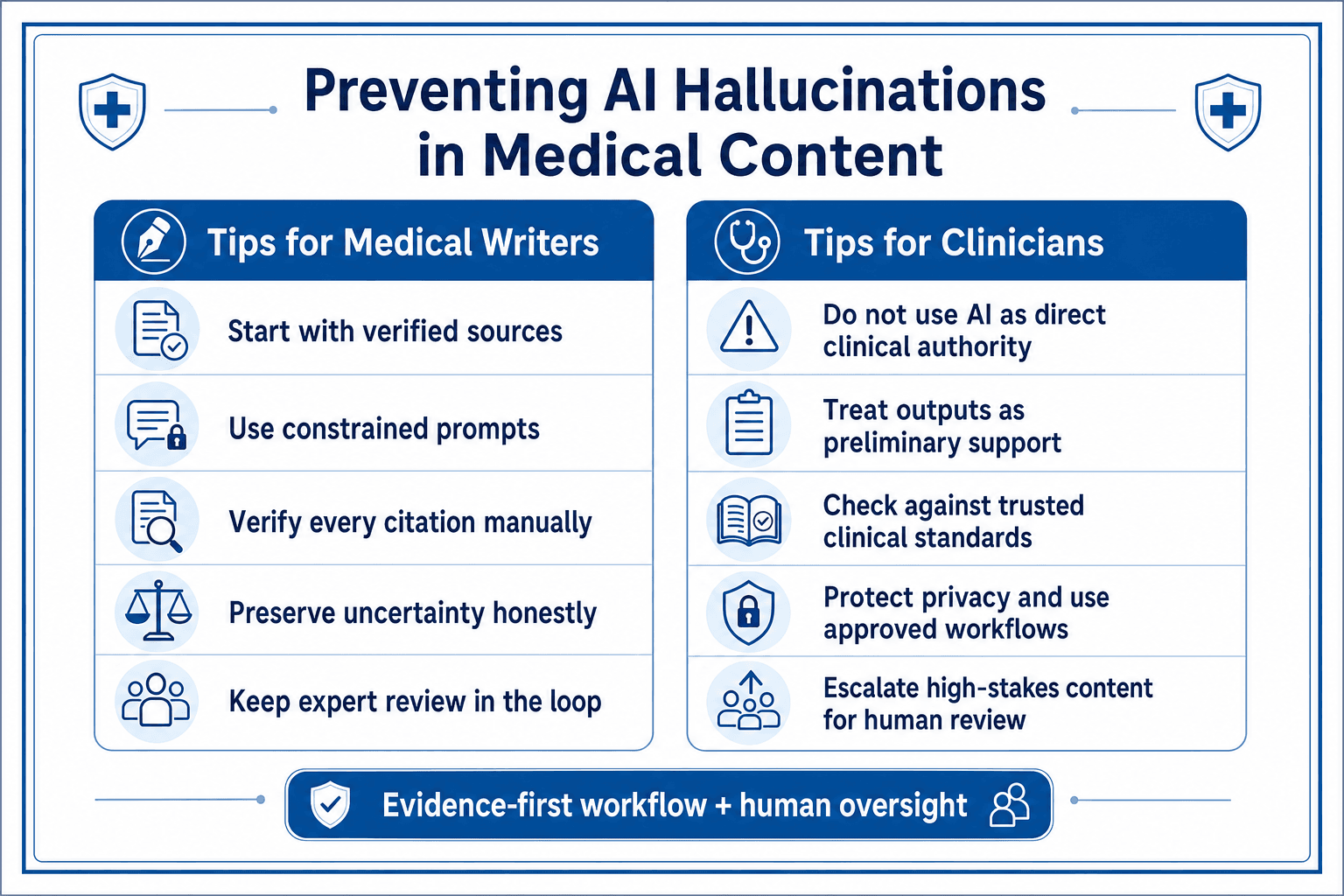
Medical AI outputs are more accurate and trusted when users select the source, review outputs, and take accountability. That means using an evidence-first workflow. An evidence-first workflow starts with trusted evidence, uses platforms that support traceability, and uses AI only to organize, summarize, or apply selected evidence to answer questions or create content for a specific audience.
II. What “Hallucination” Looks Like in Medical Content
Hallucinations in medical content can be obvious or subtle. Fabricated references or broken source attribution are obvious examples that are often missed. Subtler hallucinations include incorrect statements about efficacy, safety, dosing, contraindications, or guideline recommendations, especially when the language sounds polished enough to escape casual review.
Hallucinations may also be overgeneralization from limited evidence, misleading summaries that omit uncertainty, population limits, or study design constraints, and overconfidence in conclusions when the evidence is incomplete or conflicting.
III. Why Hallucinations Happen
A. Model architecture and prediction behavior
Large language models generate the most likely next tokens based on patterns in text; they are not designed to verify accuracy. Because they are optimized for fluency, their outputs can seem authoritative even though the content is wrong or not supported.
B. Weak source grounding
Hallucinations occur more frequently when a model does not have access to the information requested. Open-ended prompting invites unsupported synthesis. Even retrieval-based systems are not automatically trustworthy; the retrieved material still has to be relevant, sufficient, and correctly interpreted.
C. Clinical complexity
The nuance and complexity of medical information contribute to the risk of hallucination. A plausible answer can still be wrong if it is the wrong interpretation of the data.
D. Data quality problems
If the data source is incomplete, poorly written, or disorganized, models can easily misinterpret and try to fill in the missing gaps.
IV. High-Risk Use Cases for Medical Writers and Clinicians
Literature summaries, manuscripts and abstracts, slide decks and CME materials, patient education handouts, clinical decision support, documentation support in EHR workflows, pharmacovigilance, and regulatory writing are high-risk use cases because even small factual errors can propagate into published materials, clinical workflows, and high-stakes decisions.
V. Core Principle: Use an Evidence-First Workflow and Never Let AI Be the Final Source of Truth
The most effective way to prevent hallucinations is to use an evidence-first workflow. That means starting by selecting the evidence, not assuming the AI platform has the knowledge. The writer or clinician should provide authoritative sources such as literature databases, guidelines, primary studies, drug labels, and other applicable sources before using AI to draft content. The AI model should be asked to work only from those provided materials.
This is more effective than asking a general-purpose model to answer from background knowledge alone because it reduces the model's degrees of freedom, confines outputs to verifiable content, and reduces the chance that missing information will be filled with fabricated data.
AI platforms should be treated as a drafting assistant, a language simplifier, a formatting aid, or a structured brainstorming tool. It should not be treated as an expert in any field, an independent citation engine, a substitute for guideline review, or a substitute for clinical judgment. This is also important when medical AI platforms are used because there is a tendency to believe that these platforms contain all medical knowledge. This is not true, and they hallucinate when they do not have the right information.
VI. Choose the Right Platform First
Platform choice is important because the purpose and design of a system determine how well it processes scientific information and how it behaves when information is ambiguous or missing. Writers and clinicians should favor evidence-first AI platforms such as MACg that are built on state-of-the-art models, constrained to user-provided knowledge sources when provided, and designed to retrieve, analyze, and understand scientific content, rather than relying on open-ended systems optimized mainly for fluent conversation.
This matters because the right platform helps operationalize the evidence-first approach. A system that is optimized for source-grounded drafting is better positioned to keep claims tied to the literature, preserve traceability, and support auditability. Retrieval-grounded approaches are not perfect, but they are generally better aligned with medical writing needs than unconstrained generation.
The platform should be able to say “I do not know,” “the provided evidence does not answer this,” or “I cannot verify that claim from the approved sources.” Not providing a response or guiding the user to provide an appropriate knowledge source is safer than fabrication in medical content. This is how MACg is designed and one of the reasons why it is an evidence-first AI platform and is preferred by many medical writers, clinicians, and pharmaceutical companies.
VII. Understand Platform Limitations
Even strong platforms have limits. Users need to understand those limits rather than assume that retrieval alone eliminates risk or that all platforms work the same way. One practical issue is the context window. If too much evidence, too many instructions, or too many goals are loaded into a single interaction, important details may be diluted, omitted, or hallucinations may occur.
That is why it is more effective to draft medical content section by section rather than all at once. Breaking a project into smaller tasks allows each section to be paired with the relevant evidence and keeps the AI model focused on that task. An iterative workflow usually yields better outputs than a one-shot request for a complete article.
The AI model and agents used in the platform are also very important. Leading models have become more sophisticated and capable in handling complex data sets. Hallucination rates are generally lower with newer models when used within their limitations. A platform that uses older models may be prone to more hallucination risk, so it is important to know which models are used in the platform.
VIII. Practical Tips for Writers to Use AI Effectively
A. Start with verified data sources
Build drafts from literature databases, guidelines, primary studies, drug labels, institutional policies, and other applicable sources. Ask AI to work only from those materials.
B. Use constrained prompting
Prompts should instruct the model to stay within supplied sources, flag uncertainty, avoid inventing references, and separate fact from interpretation. This changes the task from “answer well” to “answer safely.”
C. Require citation verification
Use platforms like MACg that have traceability and citation generation built-in. Every cited source should be checked manually. Confirm that the article exists, the authors are correct, the conclusions are represented accurately, and the study population matches the claim being made.
D. Watch for linguistic red flags
Scrutinize absolute terms such as “always,” “never,” “proven,” and “safe.” Also verify polished claims without traceable support and numbers that are not directly confirmed in the source material.
E. Preserve uncertainty honestly
The platform should point out limitations, evidence gaps, subgroup restrictions, and areas of controversy. Removing uncertainty may make text sound cleaner, but it also makes it less credible.
F. Draft section by section and iterate
Instead of generating an entire article at once, draft one section, compare it with the evidence, refine the instructions if needed, and then move to the next section. This reduces overload and helps keep each part of the document anchored to its source base. Platforms like MACg that have built-in full-text editors support the iteration process.
G. Keep humans in the loop
Humans are the experts, not AI. Require subject-matter expert review before publication or dissemination. Human oversight should be built into the entire workflow.
IX. Practical Tips for Clinicians to Use AI Effectively
A. Do not use AI output as direct clinical authority
AI-generated content should always be verified against current guidelines, formularies, institutional protocols, and approved labeling. You are the expert, not AI.
B. Treat AI summaries as drafts
Use AI summaries to orient, not to decide. They can be useful starting points, but they are not substitutes for primary evidence review or clinical judgment. Always verify, even when using popular medical AI platforms.
C. Pay special attention to high-risk details
Double-check dosing, contraindications, drug-drug interactions, age-specific recommendations, pregnancy and lactation considerations, comorbidities, and diagnostic thresholds. These are some areas where small errors can create significant harm.
D. Protect privacy and confidentiality
Avoid entering identifiable patient data into tools that are not approved for protected health information workflows. Privacy controls are part of safe implementation, not a separate issue.
Conclusion
Using evidence-first workflows with human involvement and accountability helps prevent hallucinations and improves the quality of AI-assisted medical content creation.
The strongest safeguards against hallucinations include using an evidence-first workflow; choosing evidence-first platforms like MACg that are built on strong models, can say "I do not know", and are designed to retrieve and understand scientific content; recognizing limits such as context windows; drafting section by section, and iterating rather than asking for everything at once. Responsible and effective use of AI in medical workflows requires that AI be viewed as a tool and not as an expert in any domain. Knowing the limitations and capabilities of AI applications is essential to deriving the most benefits from them while reducing the risk of fabricated outputs and potential downstream harm.
References
Kawakita T, Wong MS, Gibson KS, et al. Application of Generative AI to Enhance Obstetrics and Gynecology Research. Am J Perinatol. 2025;42(16):2094-2103. doi:10.1055/a-2616-4182
Hong EK, Lee S, Nishino M. How I Do It: Understanding and Leveraging Generative AI for Chest Radiology Reporting. Radiology. 2026;320(2):e253456. doi:10.1148/radiol.253456
From Evidence to Publication-Ready Content—Faster
MACg brings research, writing, citations, visuals, and presentations together in one Evidence-First AI workspace.
10 Tips For Using MACg and Other AI Solutions For Medical and Scientific Writing
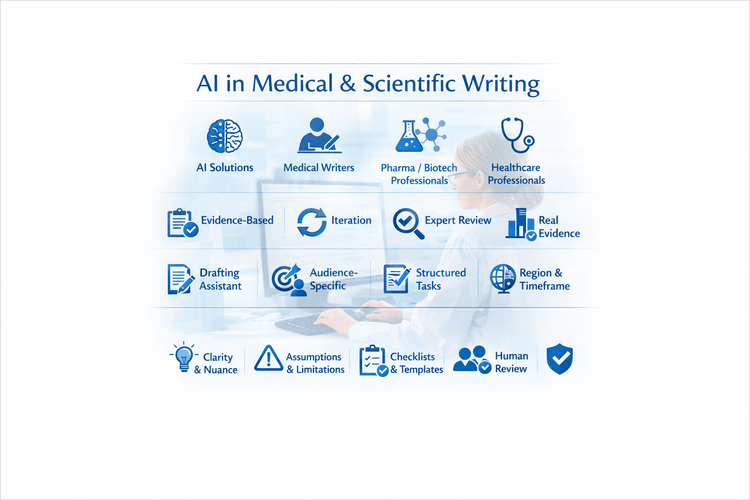
This article shares 10 practical tips for medical writers, pharma/biotech professionals, HCPs, and researchers on how to use MACg and other AI solutions effectively and responsibly. It emphasizes that MACg's AI agent training knowledge is not a citable evidence base and must be anchored in real, verifiable sources such as publications, CSRs, labels, guidelines, and internal documents. Readers are encouraged to treat all AI outputs as Version 0.1, iterating with expert review rather than accepting the first draft. The article frames MACg as a drafting and thinking assistant, not an autonomous author, and stresses the importance of clear prompts about audience, purpose, region, timeframe, and scope. It recommends breaking complex projects into smaller tasks, using MACg to improve structure and clarity, and explicitly asking for limitations and caveats. Finally, it advocates creating institutional checklists and making expert human review and sign‑off mandatory for any impactful content.

Mar 1, 2026
100 AI Slide Presentation Prompts for Busy Medical and Scientific Professionals
This article provides 100 ready‑to‑use AI prompts to help medical and scientific professionals create high‑quality slide presentations with MACg. The prompts are organized into practical categories, including clinical education, drug and mechanism‑of‑action decks, PubMed‑driven evidence reviews, specialty teaching, medical affairs and HEOR, training and curriculum, data‑visualization, and conference or grant presentations. Each prompt uses clear “Instruction:” wording and customizable placeholders (e.g., [condition], [audience], [timeframe]) so users can quickly adapt them to their specific topic and setting. By removing blank‑slide paralysis, the collection speeds up evidence‑based slide creation while supporting consistent, structured, and compliant communication.
Feb 4, 2026

AI Prompt Examples For Life Science Research And Writing
Here are ninety AI prompt templates for research and medical writing. Researchers, medical affairs, students, and healthcare professionals can use these prompts to create quality content using AI platforms.

Mar 12, 2025