AI PubMed Search & Literature Review
for Healthcare and Life Sciences
Search PubMed, analyze scientific evidence, generate structured summaries, create citations, and turn research into publication-ready content—all in one Evidence-First AI Workspace.

From Scientific Evidence to Publication-Ready Content
MACg transforms literature discovery into publication and conference-ready content with an end-to-end scientific workflow.
One Platform. Complete Literature Workflow.
Most literature search tools stop after helping you find articles.
Go beyond literature search. MACg turns trusted scientific evidence into high-impact scientific content.
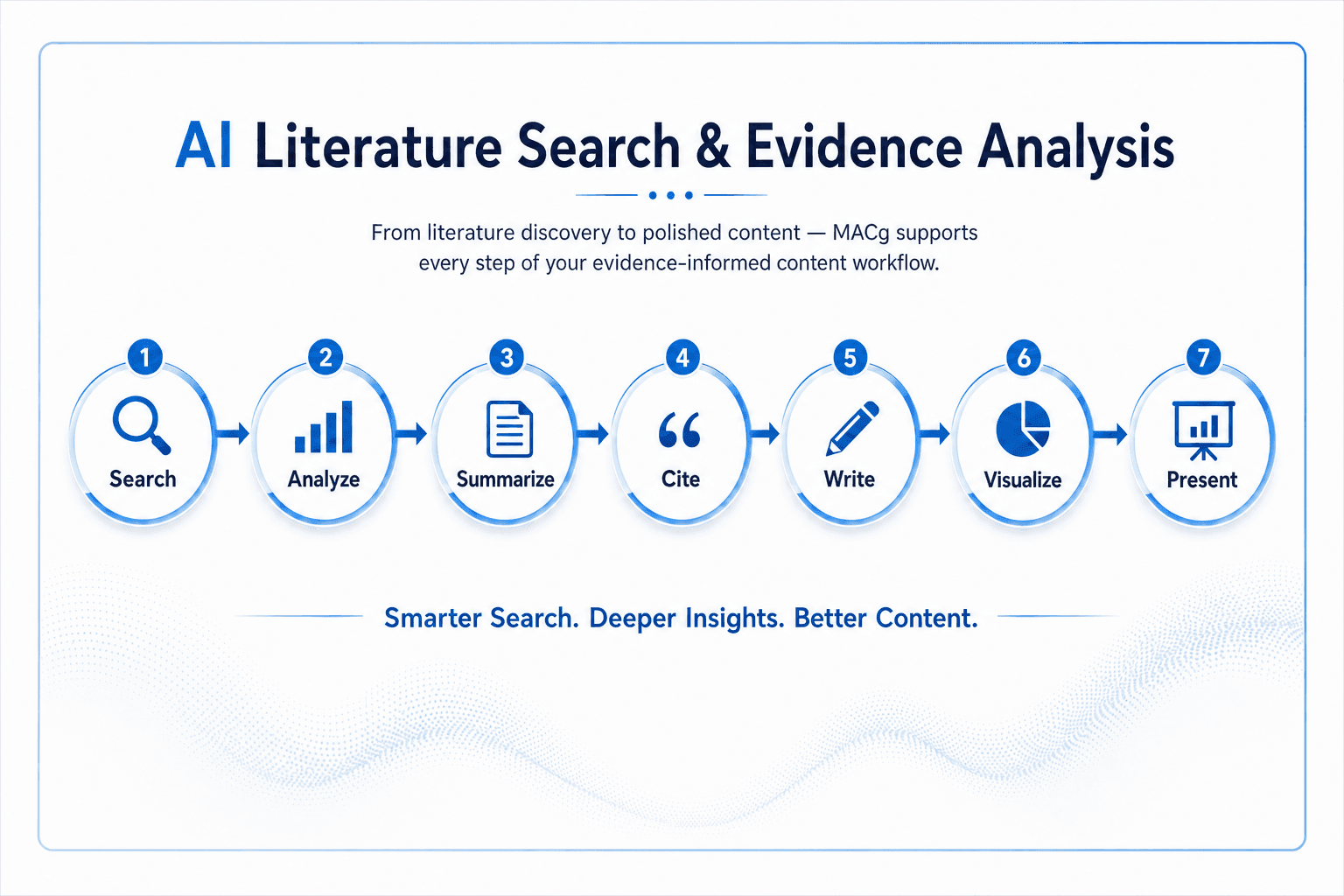
Why Scientific Professionals Choose MACg
Purpose-Built for Healthcare & Life Sciences Searches PubMed intelligently using scientific terminology, MeSH concepts, and study-specific search strategies.
Evidence-First AI Content is generated from trusted sources selected by you—including PubMed, uploaded publications, and internal scientific documents.
One Scientific Workspace Search, summarize, write, cite, create figures, and build presentations without switching between multiple applications.
Built-in Reference Management Organize publications, collaborate with teams, and generate citations automatically.
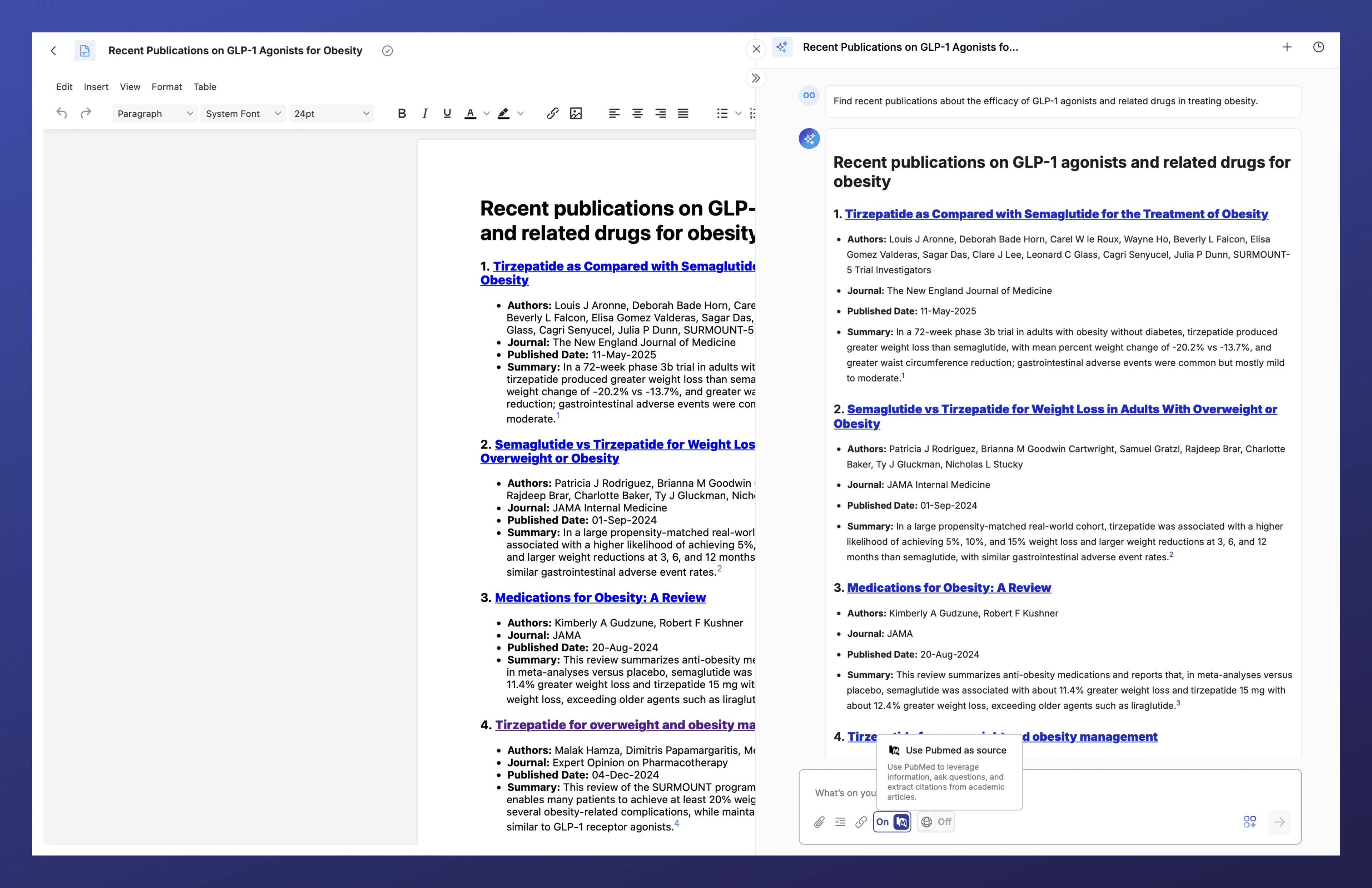

Search. Analyze. Write. Present.
Everything Starts with Trusted Scientific Evidence.
Discover how MACg helps Medical Affairs teams, researchers, and medical writers transform literature into publication-ready scientific content.
Start Your Free TrialPreviously, I relied on EndNote for citation generation, but MACg takes it further by allowing me to pull, cite, store, and manage references all in one platform seamlessly integrated with PubMed. It is designed with medical writers in mind—helping gather information, providing detailed scientific prompts, suggesting and finding relevant references, retaining links, and summarizing content—all within the same dedicated workspace. On top of that, the in-built editor makes refining content simple and efficient.

I used to spend HOURS researching a single article. Drowning in PubMed rabbit holes, juggling 15+ tabs for every project, switching between multiple Google Docs and getting lost in the process. It was beyond exhausting. I was skeptical about using AI in my process after too many garbage outputs, but I gave MACg a shot anyway. I needed an article on ADHD and nutrition, so I said, “why not?”. Within minutes, I had solid research and a pretty solid first draft. After a few quick iterations, my article was publication-ready. Time savings = unmatched. What ultimately sold me: I was able to do everything in one spot…research, prompting, drafting, writing/revisions. No more 15+ tabs for one project. (and a lot fewer headaches) If you want to drastically cut your time and get quality outputs fast, try MACg.

With MACg’s ability to integrate PubMed references directly into documents, that challenge becomes effortless. It’s more than just an AI tool—it’s an innovative platform that empowers medical writers and communicators to work smarter, not harder.

I had an international conference where this was extremely helpful.

I tried MACg in a free trial, and it delivers on scientific accuracy. I particularly like the PPT generation option.

MACg by AINGENS is a next-step technology in life science content generation. From formatting grammar to complex medical/clinical summaries, I found the MACg system to be trustworthy. It is exciting to see the progression of AI in this application and the potential benefits, time savings, accuracy, and creativity, all realized in MACg.
Core Capabilities
Natural-Language PubMed and PMC Search
Ask complex questions (population, intervention, dose, endpoints, time horizons).
AI augments queries with MeSH, synonyms, and Boolean logic; applies precise filters.
Smart Screening and Filtering
Rapid triage by study design, population, intervention/comparator, outcomes (PICO).
Adjustable inclusion/exclusion criteria; de-duplication across searches.
Draft Articles from Search Results
- Draft articles and other content directly from PubMed or PubMed Central search results.
Structured Summaries and Evidence Tables
MACg writes study summaries (objective, methods, results, safety, limitations) in seconds.
Auto-build evidence tables with key fields (n, design, endpoints, effect sizes).
Source Management and Traceability
Save results to the Reference Manager; tag, folder, and share with teams.
Extract full citations from PubMed metadata and PDFs for immediate references.
Compare Sources
Review findings from multiple sources to identify key themes and differences.
Integrated Workflow Across MACg
 Citation GeneratorAI Writing Assistant (Ask MACg)
Resources & News
AINGENS Launches A Generous Affiliate Program for MACg, The Cutting-Edge AI Platform for Life Sciences Content Creation
AINGENS, a leader in AI-driven research and medical writing innovation, announces an affiliate program for its flagship product, MACg. The program offers an attractive 30% recurring commission. The press release highlights MACg's advanced features, including AI multimodal writing assistance powered by GPT-4.0 and o3-mini, real-time integration with PubMed, automated citation support, and robust visualization tools. Additionally, MACg boasts an enterprise-grade security framework that ensures data privacy and GDPR compliance. This comprehensive announcement also emphasizes AINGENS' focus on empowering teams with fit-for-purpose AI solutions that streamline and enhance life sciences workflows, enabling users to achieve unprecedented productivity in scientific content creation. This initiative underscores AINGENS' dedication to innovation in scientific research and content creation.

Jun 26, 2025

A Real-World Review of MACg for Editing, Writing, and PubMed Search
Dr. Goldina Erowele examines the transformative role of MACg, an AI platform designed for life sciences professionals. Her initial experience involved using MACg to review a draft document and integrate PubMed references, showcasing its ability to streamline research and ensure content accuracy. MACg's tools expedite the draft review process, improving tone and readability while maintaining compliance with medical standards. The platform's applications extend to creating scientific abstracts, clinical trial reports, and training materials, promising to enhance productivity and impact in medical communications.

Jan 27, 2025
How to Efficiently Write a Scientific Review Article with MACg: Your AI-Powered Assistant for Academic Writing, Automated Research, and Citation Management
Discover how MACg, the AI-powered writing assistant, transforms the process of crafting a scientific review article. This step-by-step guide reveals how MACg automates key tasks-from defining your research scope and conducting literature searches to drafting content and creating visuals-all in under 30 seconds per task. With example prompts and insights into time savings, learn how MACg reduces the writing process from weeks to hours, allowing you to focus on analysis and innovation. Dive into the future of efficient academic writing and see how MACg can revolutionize your workflow.

Jul 26, 2025